شعار
وطن

غرفة اختبار درجة الحرارة والبيئة

غرفة اختبار درجة الحرارة والبيئة

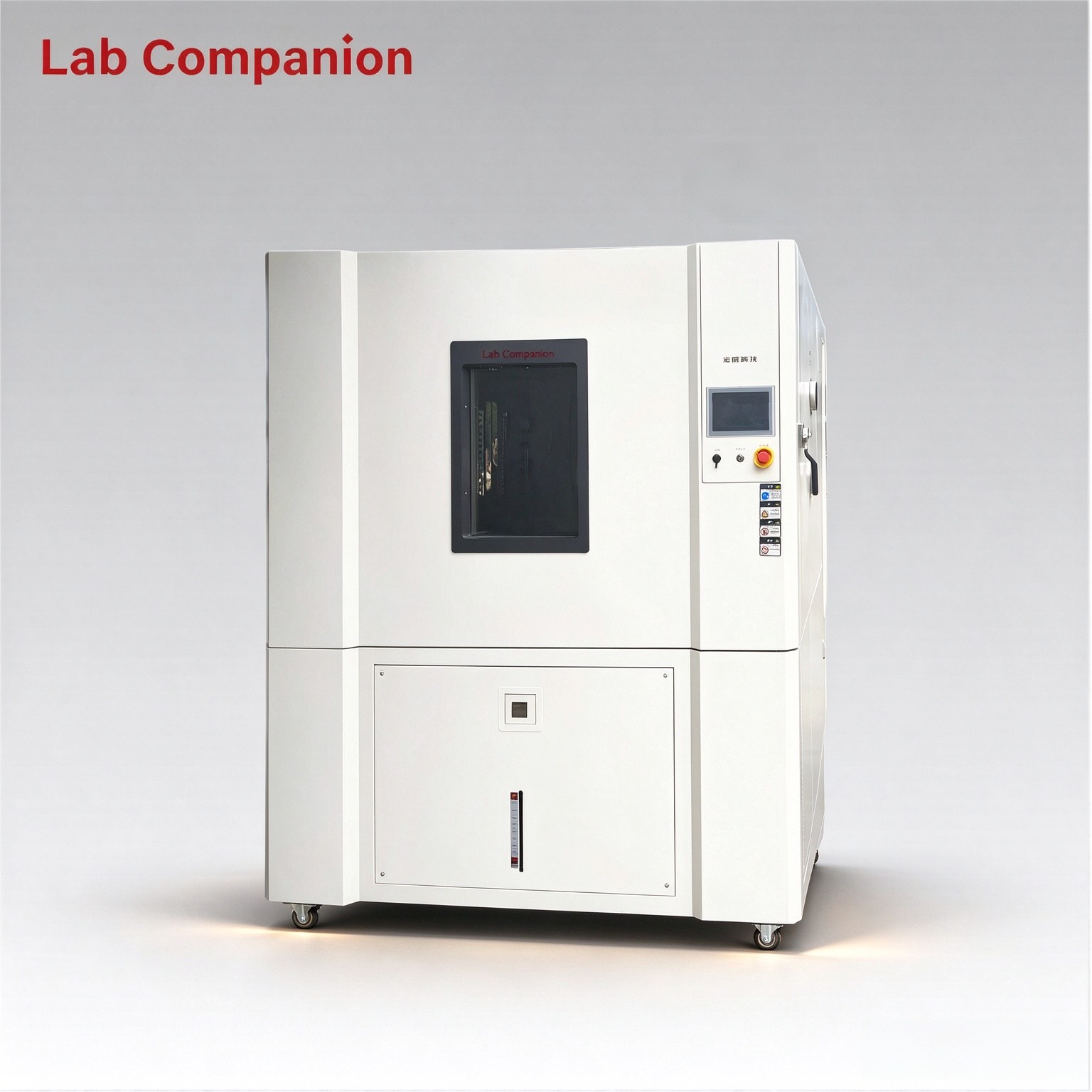
  • Lab Companion TC Series Rapid Temperature Change Test Chamber: Technical Core & Performance Advantages | Made in China
    Jul 15, 2026
    1. Core Value of Rapid Temperature Cycling Testing in Reliability Validation 1.1 Significance of Environmental Reliability Testing in Global Manufacturing In modern global industrial manufacturing, a product’s environmental adaptability and operational reliability are core determinants of its service life and market competitiveness. All mainstream industrial products, including consumer electronics, automotive components, semiconductors, and aerospace equipment, must undergo rigorous environmental reliability validation before global market launch. As a critical piece of environmental simulation testing equipment, the rapid temperature change test chamber replicates extreme and fluctuating temperature conditions encountered during product storage, transportation, and real-world service. It effectively evaluates product structural integrity and functional stability under rapid thermal variation stress. Lab Companion is a premium environmental test equipment brand rooted inChina’s advanced intelligent manufacturing industry. With over 20 years of specialized focus on reliability testing equipment R&D and production, our TC Series rapid temperature change test chamber has become a trusted solution for global enterprises. Featuring precise temperature regulation, wide temperature coverage, and multi-speed thermal cycling options, it is widely applied in Environmental Stress Screening (ESS) and high-standard product reliability verification worldwide. 1.2 Core Technical Challenges of Rapid Temperature Change Testing Compared with conventional constant temperature testing, rapid temperature cycling poses stricter technical requirements for test equipment. It demands ultra-fast response from heating and refrigeration systems to achieve drastic temperature shifts within a short period. Meanwhile, consistent temperature field uniformity and high control accuracy must be maintained throughout rapid thermal changes to prevent distorted test data and ensure valid, repeatable results. Targeting these universal industry technical pain points, Lab Companion (Made in China) has completed systematic optimization for the TC Series. With self-developed refrigeration architecture, optimized air duct structure, and intelligent adaptive control algorithms, our equipment delivers stable, high-precision performance even under high-speed temperature cycling conditions, solving the core industry challenge of balancing fast ramp rates and uniform temperature control. 2. In-Depth Interpretation of Core Technical Parameters 2.1 Ultra-Wide Temperature Range for Full-Condition Coverage Temperature coverage is the foundational indicator of environmental test chamber performance. The standard model of Lab Companion TC Series delivers a wide temperature range of -70℃ to +150℃, covering extreme low-temperature cold environments and high-temperature industrial operating conditions. It fully meets the full-temperature-cycle reliability testing requirements for most commercial and industrial products across global industries. To accommodate customized demands for high-end fields such as semiconductors and aerospace, Lab Companion supports exclusive temperature range extension solutions. As a professional Chinese manufacturing brand, we tailor ultra-low and ultra-high temperature testing configurations to match stringent international industry standards and special client testing scenarios. 2.2 Multi-Grade Temperature Ramp Rates for Flexible Testing The temperature ramp rate defines thermal stress intensity and overall testing efficiency, serving as the core performance metric of rapid temperature change chambers. The Lab Companion TC Series provides five optional ramp rates: 5℃/min, 10℃/min, 15℃/min, 20℃/min, and 25℃/min, supporting both linear and non-linear temperature variation modes. Global users can flexibly select parameters based on international test specifications and product characteristics. • 5℃/min: Suitable for conventional thermal cycling tests, simulating gradual natural ambient temperature changes for general product reliability validation. • 10℃/min: Ideal for standard environmental stress screening, achieving an optimal balance of testing efficiency and energy consumption. • 15℃/min: Applies medium-intensity thermal stress to accelerate the exposure of latent defects in precision electronic components. • 20℃/min: Enables high-efficiency stress screening, significantly shortening test cycles and accelerating customer R&D iteration and time-to-market. • 25℃/min: Supports extreme thermal stress testing to meet the rigorous verification standards of high-end semiconductor, aerospace, and precision industrial products. Taking the typical semiconductor thermal cycle test (-40℃ to +150℃) as an example, the 20℃/min ramp rate drastically reduces single-cycle testing duration, improving laboratory operational efficiency and helping global clients accelerate product launch progress. 2.3 High-Precision Temperature Control & Uniformity Maintaining precise and stable temperature control during rapid thermal cycling is the key benchmark of premium equipment quality. The Lab Companion TC Series achieves industry-leading precision performance: Temperature Deviation: ±1.5℃, Temperature Fluctuation: ±0.1~±0.5℃, Temperature Uniformity: ≤±2℃. This ensures consistent thermal conditions across the entire test workspace, guaranteeing accurate and reproducible test data. This superior precision stems from Lab Companion’s accumulated Chinese manufacturing technology advantages. The optimized closed-loop air duct structure realizes uniform internal air circulation without temperature dead zones. Equipped with high-precision sensors and self-adaptive intelligent control algorithms, the system achieves real-time dynamic temperature calibration and precise regulation throughout all test stages. 3. Analysis of Core Technical Systems 3.1 Dual-Stage Cascade Refrigeration System A high-performance refrigeration system determines the equipment’s low-temperature capacity and cooling response speed. Developed and optimized based on Chinese advanced industrial refrigeration technology, the Lab Companion TC Series adopts a high-efficiency dual-stage cascade refrigeration system. The system consists of independent high-stage and low-stage refrigeration loops connected via an evaporative condenser for efficient heat exchange. The high-stage loop provides stable condensing load for the low-stage system, while the low-stage loop directly delivers precise cooling capacity to the test chamber. This cascade design effectively reduces compressor pressure ratio, boosts overall refrigeration efficiency, and supports stable operation at -70℃ ultra-low temperature. All core refrigeration components adopt globally renowned high-quality accessories. Supported by intelligent energy regulation technology, the system automatically matches power output according to different temperature ranges and ramp speeds, ensuring long-term stable operation and low energy consumption for global users. 3.2 Q8 Intelligent Control System Lab Companion equips the TC Series with the self-developed Q8 intelligent control system, integrating AI fuzzy logic and self-tuning PID technology to realize adaptive and high-precision temperature regulation. Featuring a large full-color touchscreen with English-Chinese bilingual switching, the system delivers an intuitive and user-friendly operation interface for global users. It comes with built-in universal international test program templates and supports custom multi-segment program editing and cyclic operation, fully adapting to complex global testing process requirements. In terms of data management, the Q8 system supports real-time data display, automatic storage, one-click export, and standardized test report generation for complete data traceability and analysis. It also integrates remote monitoring functions, allowing users to view equipment operating status and test progress remotely, realizing intelligent and unmanned laboratory management. 3.3 Multi-Layer Comprehensive Safety Protection Mechanism Safety is the primary premise for long-term stable equipment operation. Adhering to strict Chinese industrial safety standards and international certification specifications, the Lab Companion TC Series is equipped with a full set of multi-dimensional safety protection mechanisms to safeguard equipment, samples, and operators. Temperature safety protection: An independent over-temperature protection device automatically cuts off heating and refrigeration power and triggers audible and visual alarms once the temperature exceeds the safe threshold, preventing sample damage and equipment failure caused by temperature runaway. System operation protection: Built-in compressor overload protection, high/low pressure protection, fan fault alarm, and leakage protection realize full-time monitoring of refrigeration and electrical systems to eliminate potential operating risks. Operational safety protection: The door safety interlock automatically pauses ongoing tests when the chamber door is opened, protecting operators from extreme temperature injuries. 4. Product Portfolio & Global Application Scenarios 4.1 Full-Size Product Matrix & Customization Capability As a reliable Chinese intelligent manufacturing brand, Lab Companion builds a complete product matrix covering diverse testing scenarios, ranging from 50L desktop compact chambers to 20m³ large walk-in thermal rooms, meeting the testing demands of different sample sizes and batch volumes. Desktop Series (50L~150L): Compact footprint and flexible operation, ideal for laboratory R&D and small component testing. Standard Series (225L~1000L): Widely applicable to module and small finished product testing, serving as the most mainstream specification for global industrial laboratories. Walk-In Series (2m³~20m³): Customizable large-space chambers for whole-machine, large-component, and multi-batch simultaneous testing. Meanwhile, Lab Companion provides professional non-standard customization services, including special temperature ranges, ultra-fast ramp rates, multi-zone temperature control, and explosion-proof designs, to deliver personalized testing solutions for global high-end clients. 4.2 Multi-Industry Global Application Benefiting from reliable quality and international standard compliance, the Lab Companion TC Series is widely exported and applied in semiconductor, automotive electronics, new energy, aerospace, communication, and medical industries worldwide. Semiconductor & Electronic Industry: Conducts environmental stress screening for chips, PCBs, and precision electronic components, accelerating the exposure of manufacturing defects and improving product reliability. Automotive Electronic Industry: Meets global automotive grade testing standards to verify the operational stability of automotive sensors, control modules, and in-vehicle systems under extreme temperature fluctuation. New Energy Industry: Performs thermal cycling tests for battery modules and BMS systems to evaluate the environmental adaptability and service life of new energy products. Lab Companion consistently delivers high-qualityMade in China environmental test equipment to support high-standard reliability verification for global high-end manufacturing industries. 5. Brand Strength & Global Service System 5.1 Independent R&D Strength & Strict Quality Control Lab Companion is backed by a national high-tech enterprise in China, specializing in the R&D and manufacturing of environmental test equipment. With over two decades of industry experience, we own independent intellectual property rights and core technologies in refrigeration systems, structural design, and intelligent control algorithms. We implement a strict full-process quality management system certified by ISO9001, ISO14001, ISO45001, and ISO27001. Every piece of equipment undergoes rigorous factory performance calibration and aging testing, ensuring stable and consistent quality for all global end users. 5.2 Global Online Technical Support & Full-Lifecycle Service Rooted in China’s advanced manufacturing base, Lab Companion focuses on global market layout and international user service. To adapt to overseas user scenarios, we provide full-lifecycle online technical support for all global clients (no on-site door-to-door service for overseas regions). Our professional international service team provides one-stop remote support covering pre-sales solution consultation, model selection guidance, equipment operation training, real-time online debugging, fault diagnosis, and regular technical maintenance guidance. We ensure 24-hour rapid global response, efficiently solving equipment operation problems remotely and guaranteeing continuous and stable laboratory testing progress for overseas users. Lab Companion — Your Reliable Made-in-China Partner for Global Environmental Reliability Testing. We will continue to empower global manufacturing quality upgrading through technological innovation and professional cross-border services.
    إقرأ المزيد
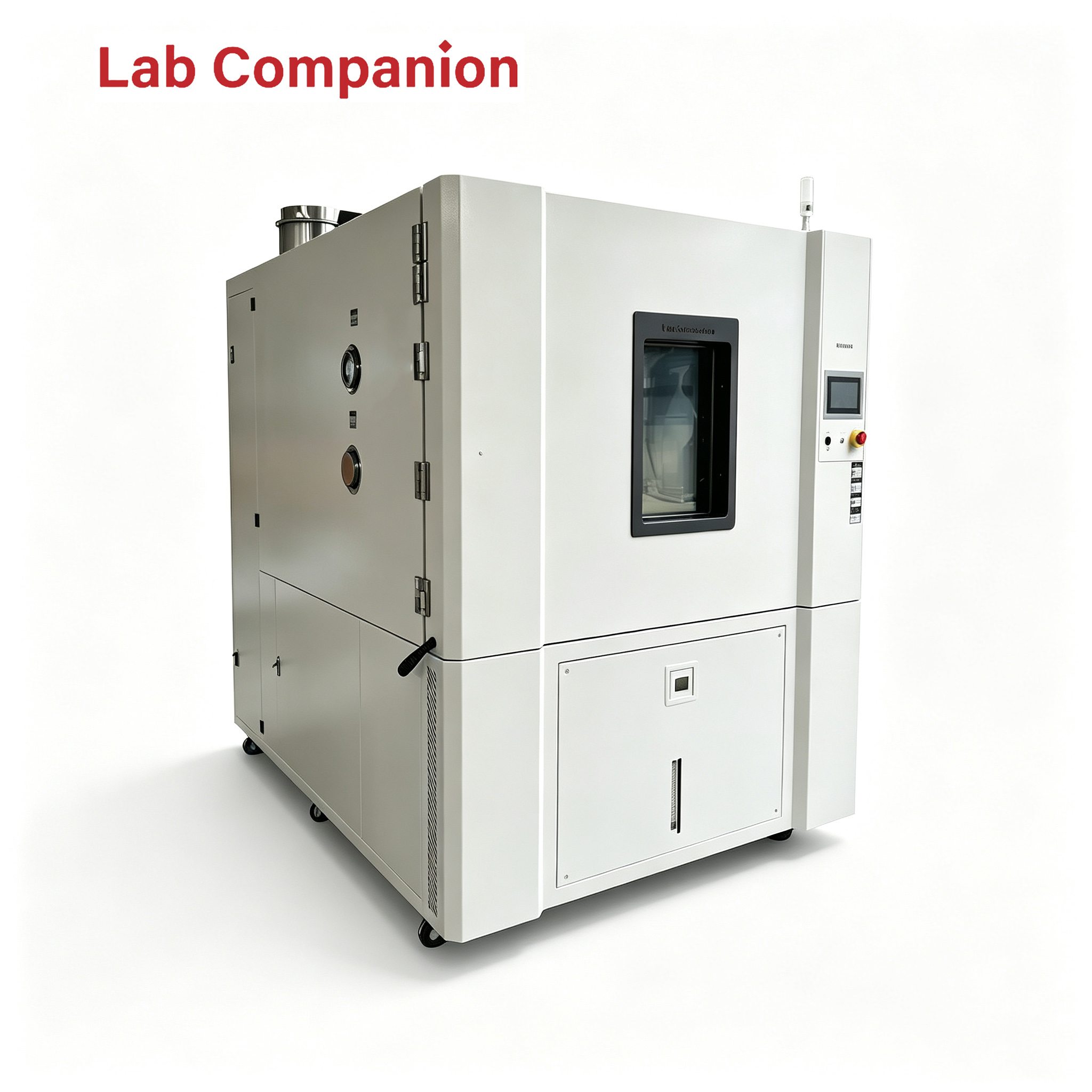
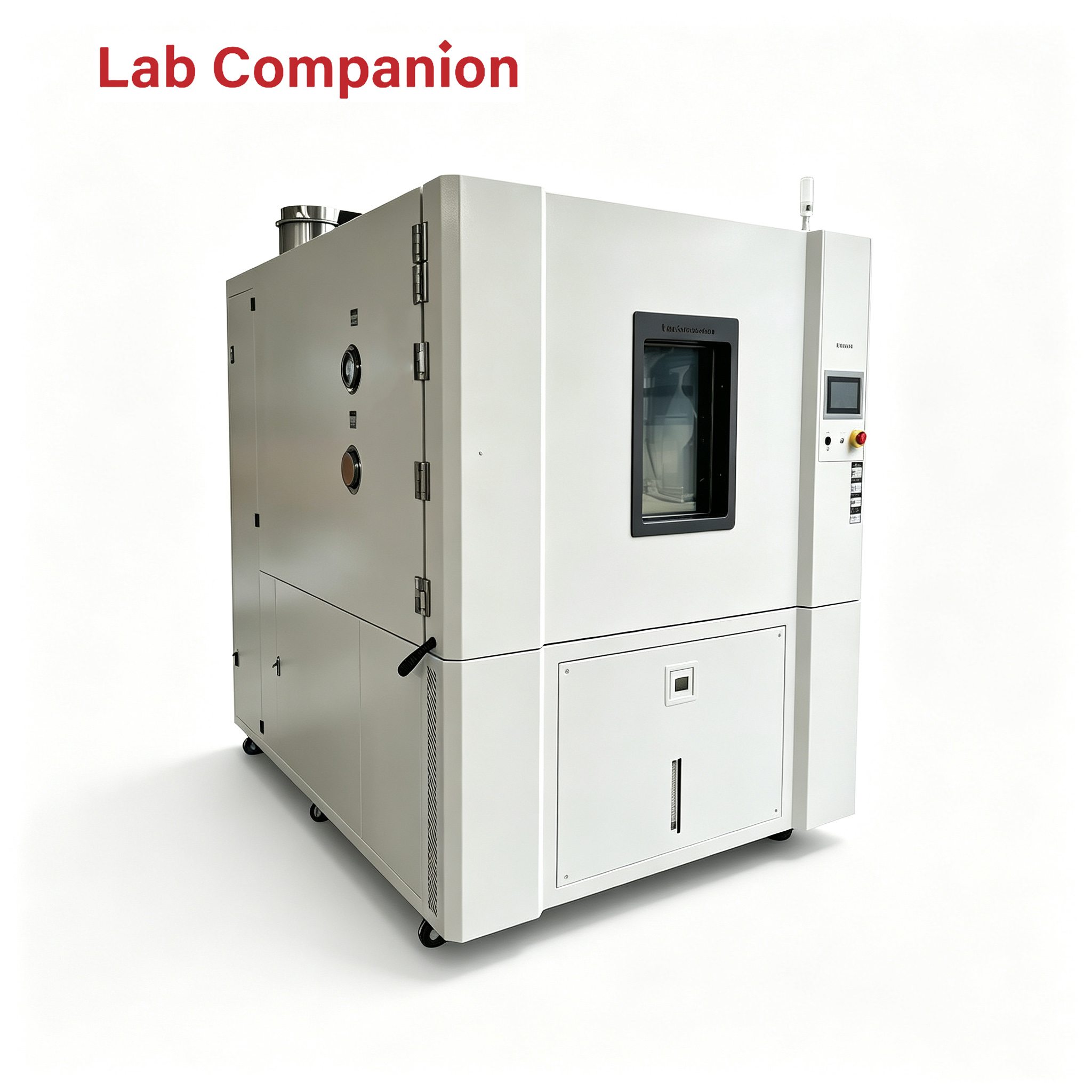
  • Lab Companion TC Series Rapid Temperature Change Test Chamber: Core Technology & Performance Advantages (Made in China)
    Jul 10, 2026
    1. Core Value of Rapid Temperature Cycling Testing for Product Reliability 1.1 Industry Importance of Environmental Reliability Testing In global modern manufacturing, product durability and environmental adaptability directly determine service life and market competitiveness. Consumer electronics, automotive components, semiconductors, and aerospace equipment must undergo strict environmental validation before mass production and global delivery. As a core piece of environmental test equipment, the rapid temperature change test chamber simulates extreme and fluctuating temperature conditions during product transportation, storage, and end-use applications. It accurately evaluates structural integrity and functional stability under aggressive thermal cycling stress. Lab Companion, a professional environmental test equipment brand based in China, has focused on reliability testing R&D and manufacturing for more than 20 years. The TC Series rapid temperature change test chamber is widely adopted globally for Environmental Stress Screening (ESS) and qualification testing. Trusted for precise temperature control, wide temperature range, and multi-rate thermal cycling flexibility, it has become a standard solution for global manufacturers and laboratories. 1.2 Technical Challenges of High-Speed Temperature Cycling Compared with standard constant temperature and humidity testing, rapid temperature cycling imposes extremely high requirements on mechanical and control systems. Fast thermal ramp rates demand ultra-fast response from heating and cooling systems. Meanwhile, uniform temperature distribution across the entire test space must be maintained to avoid inconsistent test results and invalid data. Lab Companion’s TC Series is fully optimized to solve these industry pain points. With an independently upgraded cooling system, balanced air duct structure, and intelligent PID algorithm, this Chinese-manufactured thermal test chamber delivers stable, repeatable, and accurate performance even under maximum-speed temperature cycling conditions. 2. Key Technical Parameters & Performance Highlights 2.1 Ultra-Wide Temperature Range for Full-Condition Testing The Lab Companion TC Series standard model covers a wide temperature range of -70℃ to +150℃, fully simulating extreme cold, normal ambient, and high-temperature industrial working conditions. This extensive coverage supports full-temperature-range reliability verification for most commercial and industrial products worldwide. For advanced industries such as semiconductors and military-grade manufacturing, customized temperature range expansion is available. As a professional Chinese manufacturer, Lab Companion provides tailored solutions to meet ultra-low and ultra-high temperature testing requirements for high-end global clients. 2.2 Multi-Rate Temperature Ramp Options for Flexible Testing Temperature ramp rate is the critical indicator that determines stress intensity and testing efficiency. The TC Series offers five standard ramp rates: 5℃/min, 10℃/min, 15℃/min, 20℃/min, and 25℃/min, supporting both linear and non-linear temperature change modes. Global users can select the optimal rate according to international standards and product specifications. • 5℃/min: Simulates natural gradual temperature changes, ideal for general environmental reliability testing. • 10℃/min: Balances testing efficiency and energy consumption perfectly, suitable for mass production screening of most standard industrial products. • 15℃/min: Applies medium-level thermal stress to expose potential latent defects in precision electronic components. • 20℃/min: High-stress accelerated cycling, greatly shortens test cycles and accelerates R&D iteration. • 25℃/min: Extreme rapid thermal cycling for stringent qualification of aerospace, semiconductor, and high-end industrial products. For typical semiconductor temperature cycling tests from -40℃ to +150℃, the 20℃/min rate significantly reduces single-cycle testing time, helping global laboratories improve throughput and speed up product launch schedules. 2.3 High-Precision Temperature Uniformity & Stability Precise temperature control during fast thermal cycling is the core benchmark of chamber quality. Lab Companion TC Series achieves industry-leading precision: Temperature Deviation: ±1.5℃, Temperature Fluctuation: ±0.1~±0.5℃, Temperature Uniformity: ≤±2℃. It ensures consistent thermal conditions throughout the test workspace for highly repeatable and reliable test data. Supported by an optimized closed-loop air circulation system and high-sensitivity sensor modules, the intelligent control system realizes real-time dynamic temperature adjustment, eliminating temperature dead zones and ensuring stable performance during long-term continuous operation.   3. Core System Design & Technical Advantages 3.1 Dual-Stage Cascade Refrigeration System The cooling system determines low-temperature performance and cooling speed. Developed and optimized independently by our Chinese R&D team, the TC Series adopts a high-efficiency dual-stage cascade refrigeration system. The system consists of high-stage and low-stage refrigeration loops connected via a condenser-evaporator for efficient heat exchange. The high-stage loop provides stable condensation capacity, while the low-stage loop delivers precise cooling capacity to the test chamber. This design effectively reduces compressor pressure ratio, improves overall cooling efficiency, and achieves stable ultra-low temperature performance down to -70℃. All core refrigeration components adopt international premium brands. Equipped with intelligent energy adjustment technology, the system automatically matches power output according to different temperature sections and ramp rates, ensuring stable operation and lower energy consumption for global users. 3.2 Q8 Intelligent Control System Lab Companion equips the TC Series with the self-developed Q8 intelligent control system, integrating AI fuzzy logic and self-tuning PID technology to achieve adaptive and precise temperature regulation. The system features a user-friendly large-color touchscreen with English-Chinese bilingual switching. Built with abundant standard test program templates and customizable multi-segment cycle logic, it easily adapts to complex international test standards. It supports real-time data display, automatic data storage, one-click data export, and automated test report generation. Remote monitoring function allows users to check device status and test progress remotely, realizing intelligent and unmanned laboratory management. 3.3 Multi-Layer Safety Protection Mechanism Safety is the fundamental guarantee for laboratory operation. Manufactured with strict Chinese industrial safety standards and international certification requirements, the TC Series is equipped with comprehensive multi-dimensional safety protection functions. Over-temperature protection: Independent temperature limit cut-off design triggers power cutoff and audible-visual alarm to protect test samples and equipment. System operation protection: Compressor overload, high/low pressure protection, fan failure alarm, and leakage protection ensure long-term stable operation. Operation safety interlock: The chamber door safety interlock automatically pauses testing once the door is opened, preventing high/low-temperature injury to operators. 4. Product Portfolio & Global Application Scenarios 4.1 Full-Size Product Matrix & Customization Service As a reliable Chinese manufacturer, Lab Companion provides a complete product size range to meet diverse testing demands, covering desktop small chambers to large walk-in thermal rooms. Desktop Series (50L~150L): Compact and flexible, ideal for R&D laboratories and small component testing. Standard Series (225L~1000L): The most popular global model for modules and small finished product batch testing. Walk-In Series (2m³~20m³): Customizable large space for whole-device, component, and multi-batch simultaneous testing. We also support full non-standard customization, including special temperature ranges, ultra-fast ramp rates, multi-zone temperature control, and explosion-proof design, providing exclusive solutions for global high-end clients. 4.2 Global Industry Applications With reliable quality and international standard compliance, Lab Companion TC Series has been widely exported and applied in semiconductor, automotive electronics, new energy, aerospace, medical, and communication industries worldwide. Semiconductor & Electronics: Accelerated thermal stress screening for chips, PCBs, and electronic components to eliminate latent manufacturing defects. Automotive Electronics: Complies with global automotive testing standards to verify the stability of automotive sensors, control units, and in-vehicle systems under extreme temperature fluctuation. New Energy Industry: Thermal cycling testing for battery modules and BMS systems to evaluate environmental adaptability and service life of new energy products. Lab Companion continues to deliver high-qualityMade in China environmental test equipment for high-end reliability verification across global industries. 5. Chinese Manufacturing Strength & Global Service Support 5.1 Independent R&D & Strict Quality Control Lab Companion belongs to a national-level high-tech enterprise in China with professional R&D capabilities and independent intellectual property rights. With 20+ years of experience in environmental test equipment manufacturing, we insist on independent innovation in refrigeration technology, structural design, and intelligent control algorithms. All products are manufactured under standardized ISO quality systems (ISO9001, ISO14001, ISO45001, ISO27001). Every chamber undergoes strict factory calibration and aging testing to ensure stable and consistent quality for global customers. 5.2 Global Service System & 24-Hour Support Headquartered in North China with a modern intelligent manufacturing base in Dongguan, South China, Lab Companion has built a complete service network covering the global market. We provide full-lifecycle services including pre-sales technical consultation, model selection, customized solution design, on-site installation and commissioning, operational training, and after-sales maintenance. We support 24-hour rapid response to ensure stable and continuous operation of customer laboratory equipment. Lab Companion — Reliable Made-in-China Environmental Test Solution Partner for Global Industries.
    إقرأ المزيد
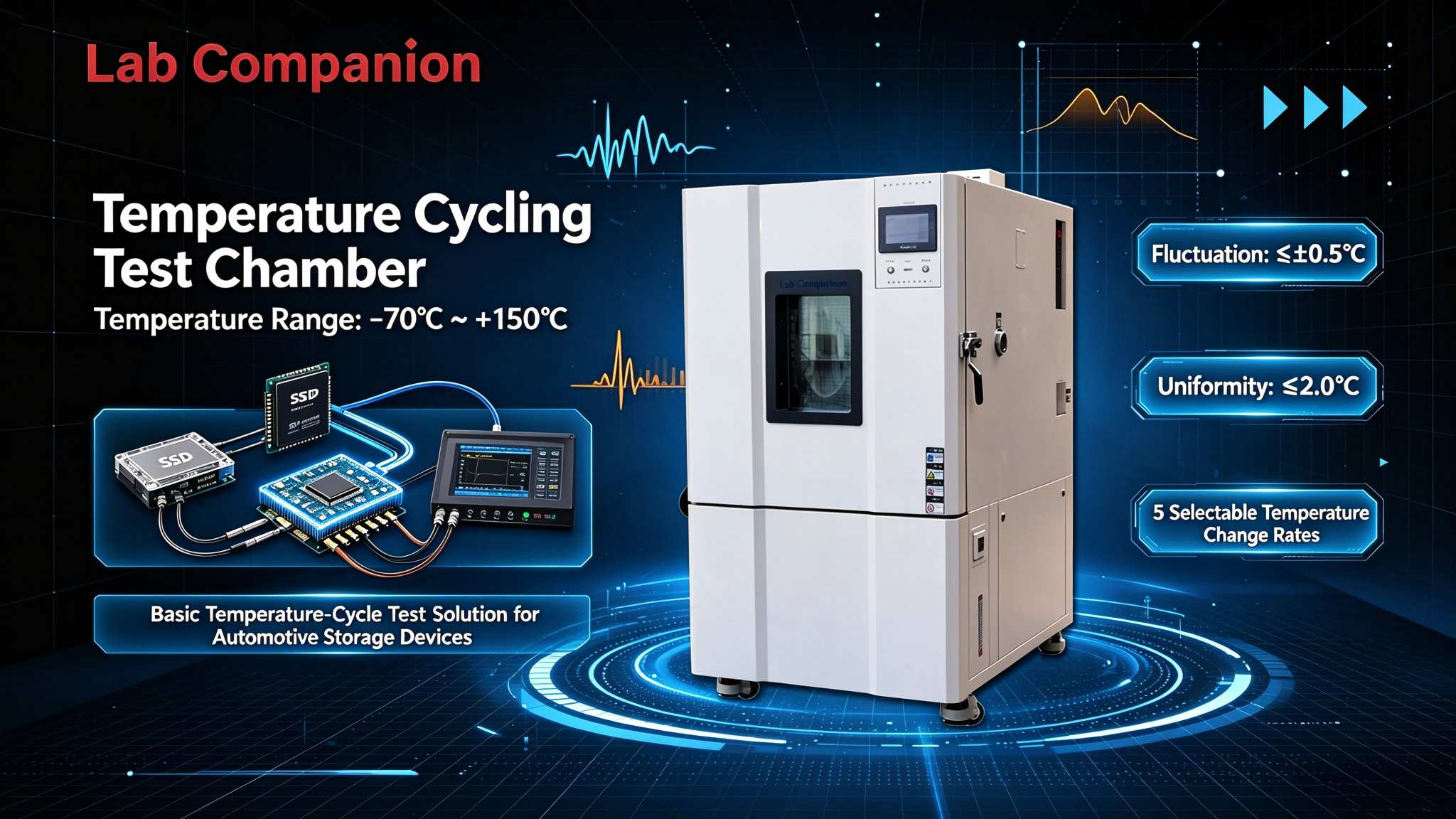
  • Lab Companion Q8 Intelligent Control System: AI + Dual PID for Ultra-Precise Thermal Testing
    Jun 29, 2026
    In environmental reliability testing, the overall performance of a rapid temperature   change test chamber depends not only on powerful refrigeration and fast-response heating hardware, but more critically, on the intelligence of its control system. Serving as the core brain of the test equipment, the control system senses real-time temperature fluctuations, regulates cooling and heating output, executes complex thermal cycling profiles, and records full-process test data. A high-performance control system maximizes hardware potential, delivering higher testing accuracy, simpler operation, and fully traceable, repeatable test results. With 21 years of professional manufacturing experience in environmental test equipment, Lab Companion is a leading Chinese manufacturer focused on R&D and production of high-reliability testing solutions. To accommodate diverse testing requirements across global industries, we have built a dual-control system matrix: the classic C100 PID control system for standard daily testing, and the advanced Q8 AI intelligent control system for high-end, high-precision testing scenarios. Backed by robust China-based R&D and manufacturing facilities and a standardized global service system, Lab Companion delivers reliable dual-control solutions for worldwide clients. For international users, we provide full-range online technical support, including system operation guidance, remote diagnosis, and online software upgrades, ensuring stable and efficient equipment operation without on-site service. 1. C100 Control System: Classic PID + Fuzzy Logic for Stable Standard Testing 1.1 Positioning: Cost-Effective & Reliable for General Applications Developed independently by Lab Companion, the C100 temperature and humidity control system is widely deployed on our TC/TH series rapid temperature change chambers and constant temperature & humidity chambers. Designed with simplified operation and stable performance as core advantages, it perfectly fits general reliability testing for electronic components, consumer electronics, and standard automotive parts. 1.2 Core Functional Features The C100 system integrates comprehensive practical functions to streamline testing workflows and ensure consistent operational stability: • Power-On Self-Check: Automatically inspects all sub-system statuses upon startup to guarantee equipment health before testing. • Linear Temperature & Humidity Calibration: Supports sensor linear correction to eliminate long-term drift and sustain data accuracy. • Smart Timing Control: Enables automatic shutdown after test completion and scheduled startup, optimizing laboratory operation efficiency. • Adaptive Subsystem Collaboration: Automatically coordinates refrigeration, heating, and vacuum operation to maintain precise control across the full temperature range. • Visual Fault Alarm: Displays clear fault prompts for quick troubleshooting and minimal downtime. • Historical Data Storage: Saves test data, trend curves, and fault records for complete test traceability. 1.3 Patented Cold-End Balance Energy-Saving Technology Equipped with Lab Companion’s patented energy-saving control technology, the C100 system optimizes the coordination logic of cooling and heating. It effectively avoids the traditional energy waste caused by simultaneous refrigeration and heating, greatly reducing operational power consumption. Meanwhile, it lowers compressor load and extends the service life of core equipment components, bringing long-term cost savings for laboratories. 2. Q8 Intelligent Control System: AI + Dual PID Fusion Redefines Smart Testing While the C100 system serves as a stable and cost-effective solution for standard testing, the Q8 intelligent control system acts as Lab Companion’s flagship intelligent core for sophisticated testing scenarios. It breaks the limitations of traditional fixed-parameter PID control through deep integration of AI fuzzy algorithms and dual PID dynamic regulation, achieving industry-leading precision and anti-interference performance. 2.1 AI Dual-Algorithm Fusion: Core Engine for Ultra-Stable Temperature Control Conventional single PID controllers rely on fixed parameters, easily causing temperature overshoot, response lag, and data deviation when facing variable sample heat capacity, rapid temperature changes, and load fluctuations. The Q8 system solves these pain points with three core intelligent capabilities: • Dynamic Adaptive Control: The AI algorithm analyzes real-time temperature trends, predicts system operating status, and dynamically adjusts cooling and heating power, realizing zero overshoot and zero steady-state error precision control. • Intelligent Load Identification: Automatically recognizes sample thermal load characteristics and matches optimal control parameters. It stably supports high-heat-generating samples such as AI servers and power batteries, with a maximum temperature change rate of 25℃/min and consistent operation stability. • Anti-Interference Compensation: Real-time monitors ambient temperature and power supply fluctuations, and automatically compensates temperature deviations. It delivers a test data repeatability of over 99.5% under complex external environments. Within the ultra-wide temperature range of -70℃ to 150℃, the Q8 system maintains a temperature fluctuation of ≤±0.3℃ and uniformity of ≤±0.5℃. For high-precision semiconductor testing, it can further achieve ±0.2℃ fluctuation and ±0.4℃ uniformity, fully meeting strict international industrial standards. 2.2 Large-Capacity Programmable Editing for Complex Profiles The Q8 system supports massive program storage, capable of saving thousands of custom test routines and tens of thousands of temperature change steps. The graphical program editor allows users to freely design arbitrary complex time-temperature curves, including linear ramping, nonlinear shock, constant temperature, and cyclic testing. Built-in mainstream international standard test libraries enable one-click startup of standard tests without complicated manual parameter setup, greatly improving operational efficiency. 2.3 72-Hour Unattended Continuous Operation Built for automated and low-labor laboratory operation, the Q8 system supports 72-hour uninterrupted continuous operation. After program activation, the equipment automatically completes full-process ramping, soaking, cooling, and cycle switching without on-site attendance. The power-off memory function automatically resumes suspended tests after power recovery, preventing test interruption and data loss for long-duration reliability experiments. 2.4 IoT Remote Management & Cloud Data Traceability Equipped with a standard industrial IoT module, the Q8 system builds a full-link intelligent management system of “Device-Cloud-Terminal”, enabling global remote monitoring and data management for overseas users: • Multi-Terminal Remote Monitoring: Check real-time equipment status, temperature curves, and test progress via mobile APP or web browser anytime, anywhere. • Remote Program Management: Cloud storage, remote calling, parameter modification, and one-click start/stop of test programs. • Cloud Data Backup & Sharing: Automatic cloud synchronization of test data, supporting multi-user remote access and analysis. • Automatic Report Generation: Collects multi-point temperature data in real time, automatically generates data tables and trend graphs, and stores up to 600 days of historical data for full compliance traceability. 2.5 Predictive Maintenance & Intelligent Fault Diagnosis The Q8 system embeds a full-coverage self-inspection module to continuously monitor the operating status of compressors, sensors, fans, and heating components. Powered by AI health trend analysis, it achieves a fault prediction accuracy of 99.95%. Once abnormalities occur, the system automatically pops up detailed prompts for fault causes, locations, and standardized solutions, helping users eliminate hidden risks in advance and reduce equipment downtime. 3. Industrial-Grade Hardware Platform for Long-Term Stability Both C100 and Q8 systems adopt high-standard industrial hardware configurations. The Q8 system is equipped with a high-performance industrial processor and a high-resolution hardened color touch screen (7-inch standard, 10.4-inch optional). The screen features waterproof, oil-proof, and vibration-resistant properties to adapt to complex laboratory environments. All core executive components such as contactors and circuit breakers adopt world-renowned brands, ensuring precise and reliable long-term operation of every instruction. 4. Global Online After-Sales & Technical Support As a professional Chinese environmental test equipment manufacturer with complete independent R&D and manufacturing capabilities, Lab Companion provides global unified online technical services for all international users (no on-site door-to-door service for overseas markets). All technical teams are professionally trained by the China headquarters, delivering standardized and consistent global service quality. For global clients using C100 and Q8 control systems, we provide full-lifecycle online support: • Pre-Sales Customized Solution: Recommend optimal C100/Q8 system solutions according to industry test standards, sample specifications, and testing requirements. • Online Operational Training: Provide remote one-on-one guidance for system operation, program editing, data export, and basic troubleshooting. • Online Software Upgrade & Iteration: Support remote system function updates and standard iteration to adapt to the latest industry testing specifications. • Remote Fault Diagnosis & Support: Technicians remotely view equipment operating data, locate faults quickly, and provide professional solutions. 5. System Selection Guide • C100 Control System: Ideal for general environmental reliability testing. Featuring simple operation, stable performance, and energy efficiency, it is the cost-effective choice for standard testing of electronic components, consumer electronics, and conventional automotive parts. • Q8 Intelligent Control System: Designed for high-end and rigorous testing scenarios requiring ultra-high precision, intelligent automation, and remote management. It is the preferred solution for semiconductors, AI computing equipment, new energy batteries, and professional third-party testing laboratories worldwide. 6. Conclusion The control system defines the core performance of thermal test equipment, determining testing precision, operational efficiency, and data credibility. As a matureChina-based manufacturer with two decades of industry experience, Lab Companion builds a comprehensive dual-control system matrix covering standard to high-end intelligent testing scenarios. The Q8 intelligent control system, empowered by AI + dual PID fusion technology, achieves micron-level temperature control accuracy, full-process unattended automation, IoT remote management, and AI predictive maintenance. Supported by standardized global online technical services, it delivers reliable, efficient, and intelligent environmental testing solutions for worldwide industrial and laboratory clients.
    إقرأ المزيد
  • Lab Companion Full-Scale Chamber Selection Guide:Precision Solutions for Global Environmental Reliability Testing
    Jun 26, 2026
    Environmental reliability testing demands highly customized equipment solutions across industries. Semiconductor R&D requires compact, high-precision bench-top chambers; new energy battery testing needs large-volume floor-standing units; and full-product qualification relies on walk-in test rooms for full-scale system validation. Improper chamber selection is a common global pain point. Oversized chambers lead to excessive energy consumption and unnecessary budget waste, while undersized units result in poor temperature uniformity and invalid test data. Insufficient temperature change rates will drastically reduce testing efficiency and delay project verification. Lab Companion, a professional manufacturer with 21 years of experience in environmental test equipment, offers a full-range product portfolio covering 34L bench-top to 8000L walk-in rapid temperature change chambers. Rooted in China’s advanced intelligent manufacturing system, the brand owns multiple professional R&D and production bases, delivering standardized and customized testing solutions for global clients in electronics, new energy, automotive, aerospace, and military industries. This official selection guide summarizes core selection criteria based on international test standards and global industrial demands, covering volume specification, temperature range, temperature change rate, and control accuracy, helping overseas users select the most suitable chamber efficiently. 1. Volume Selection:Match Chamber Size to Test Samples Volume is the primary factor for reliable and cost-effective testing. Reasonable chamber size ensures smooth internal air circulation, stable temperature uniformity, and qualified test repeatability. 1.1 Core Selection Rule Effective Rule:Sample Volume ≤ 1/3 of Chamber Inner Volume Reserve sufficient internal space for airflow circulation to avoid blocked ventilation caused by overloaded samples, which prevents temperature deviation and unqualified test results. 1.2 Bench-Top Series (34L~180L):For R&D and Miniature Component Testing Compact and space-saving, the bench-top series is specially designed for laboratory R&D scenarios with limited space and small test samples. All models support a temperature range of -70℃ to +150℃ and are fully CE certified to meet international quality specifications. • 34L~64L:Ideal for R&D verification of chips, PCB boards, camera modules, and micro electronic components • 100L~180L:Suitable for batch reliability screening of communication modules, sensors, and medium-sized electronic parts 1.3 Industrial Floor-Standing Series (225L~1000L):For Batch & Medium-to-Large Sample Testing Industrial-grade chambers balance testing capacity, stability, and efficiency, perfectly matching mass production testing and medium-to-large component validation. • 225L:Universal model for automotive electronics, BMS controllers, and standard communication components • 408L~600L:Optimized for new energy battery modules, vehicle displays, and server motherboards • 800L~1000L:Applicable for large PCB panels, communication cabinets, and complete small system reliability testing 1.4 Walk-In Series (1000L~8000L+):For Full-Size Equipment & Super-Large Samples Lab Companion walk-in rapid temperature change chambers are designed for oversized test objects, including AI server cabinets, full-size battery packs, and industrial complete equipment. We supportfull-scale customized volume solutions from small non-standard sizes up to 20m³ ultra-large test rooms, catering to aerospace, military, and high-end industrial research scenarios. 2. Temperature Range:Standardized & Customizable for Global Industrial Standards Lab Companion TC/TH series rapid temperature change chambers feature a standard temperature range of -70℃ to +150℃, with multiple low-temperature options (-40℃/-50℃/-60℃/-70℃). For extreme industrial and scientific scenarios, customized ultra-wide temperature ranges (-100℃ to +250℃) are available to meet strict international military and aerospace standards. Industry-matched temperature ranges and corresponding global test standards are listed below: Industry Recommended Temperature Range Applicable International Standards Consumer Electronics & Home Appliances -40℃ ~ 85℃/150℃ IEC 60068-2-38 Automotive Electronics & New Energy -40℃ ~ 125℃ AEC-Q100, ISO 16750-4 Semiconductor & Chip -55℃ ~ 150℃ JEDEC JESD22-A104 Aerospace & Military Industry -70℃ ~ 180℃ (Customizable) GJB 150A 3. Temperature Change Rate:Core Index of Testing Efficiency Temperature change rate is the key difference between rapid temperature change chambers and ordinary high-low temperature chambers, directly determining overall testing cycle and efficiency. 3.1 Multi-Grade Rate Options Lab Companion TC/TH series provides 5℃/min, 10℃/min, 15℃/min, 20℃/min, 25℃/min linear and non-linear temperature change modes. Optional liquid nitrogen auxiliary cooling supports a maximum cooling rate of 30℃/min for high-intensity accelerated aging tests. The effective rate is stably guaranteed within -55℃~+125℃ for authentic and consistent test performance. 3.2 Industry Rate Matching Guidelines • 5~10℃/min:Cost-effective for consumer electronics and conventional laboratory R&D testing • 10~15℃/min:Mainstream choice for automotive electronics and new energy BMS system qualification • ≥15℃/min:For high-reliability scenarios including vehicle-grade electronics, aerospace, and military product verification 3.3 Key Selection Tip:Focus on Load-Bearing Rate Most manufacturers only mark no-load rate (empty chamber data), while actual sample heat capacity will reduce real operating rate. Lab Companion provides professional load-bearing test data according to client sample characteristics, ensuring all parameters match real working conditions without virtual calibration. 4. Temperature Accuracy & Uniformity:Guarantee Test Data Validity Stable temperature accuracy and uniformity ensure test repeatability and data traceability, complying with global mainstream testing specifications. Core Precision Parameters • Temperature Fluctuation: ≤0.5℃ • Temperature Deviation: ±2℃ • Temperature Uniformity: Full-load 9-point temperature measurement, compliant with GB/T 2423.22 Adopting low-resistance air duct and forced convection circulation design, all chambers deliver uniform internal temperature distribution. SUS304 stainless steel inner tank and high-density composite insulation structure effectively reduce temperature loss. The TH series adds independent humidity control (20%~98% RH) to support comprehensive temperature & humidity coupled testing. 5. Global Service & Manufacturing Support (China Manufacturing Base) As a top-tier environmental test equipment manufacturer in China, Lab Companion owns standardized modern R&D and manufacturing bases, adopting unified global production standards, quality control systems, and technical specifications for all products. All equipment is fully assembled and strictly inspected in China before global delivery, ensuring consistent quality for worldwide clients. To adapt to global overseas business scenarios, Lab Companion provides 100% remote full-cycle technical support for all international users: • Pre-sales Remote Consulting:Professional technical team provides one-on-one customized solution selection according to client industry standards, sample parameters, and test requirements • Online Installation & Commissioning Guidance:Detailed English operation manuals, video tutorials, and real-time remote guidance for equipment installation, parameter setting, and trial operation • Global After-Sales Support:24/7 remote fault diagnosis, technical troubleshooting, software upgrade guidance, and maintenance guidance; standardized global spare parts supply system ensures efficient after-sales service • Global Customization Service:Support personalized customization of temperature range, volume size, temperature change rate, and functional modules to meet special industrial testing demands 6. Standard Selection Process & Recommendations Follow the 4-step standardized process to select the optimal Lab Companion rapid temperature change chamber: Step 1. Confirm Test Requirements:Clarify sample size, weight, material, required temperature range, temperature change rate, and targeted international test standards Step 2. Match Chamber Volume:Follow the 1/3 volume rule to select bench-top, industrial floor-standing, or walk-in specifications Step 3. Verify Core Performance:Confirm load-bearing temperature change rate, temperature accuracy, uniformity, and optional humidity function Step 4. Acquire Global Technical Support:Contact Lab Companion international sales team for professional solution confirmation, customization service, and full-cycle remote technical support 7. Conclusion Lab Companion rapid temperature change chambers deliver full-size coverage, ultra-wide temperature range, multi-grade adjustable rate, and high-precision temperature control. Supported by China’s mature intelligent manufacturing system and global standardized remote service system, we provide reliable, cost-effective, and fully customized environmental reliability testing solutions for global industrial and scientific research clients.
    إقرأ المزيد
  • From Chips to Modules to Vehicles: Full-Standard Compliance of Lab Companion EMC Shielded Thermal Cycling Chambers
    Jun 24, 2026
    1. Standard-Driven Testing Upgrade for Semiconductor & Automotive Electronics Semiconductor and automotive electronic reliability testing is governed by two globally authoritative standard systems: the JEDEC JESD22 series for semiconductor components and theAEC-Q series for automotive-grade electronics. As the core mandatory environmental stress test for both standards, thermal cycling and rapid temperature change testing verifies the long-term durability and structural stability of electronic products under extreme temperature conditions. With continuous tightening of industrial certification specifications, conventional thermal chambers can no longer meet upgraded compliance requirements. JEDEC JESD22-A104 imposes strict constraints on test temperature ranges and temperature ramp rates, while AEC-Q100 strictly regulates ramp speed, extreme temperature dwell time and cycle counts for automotive qualification. The combination of thermal cycling stress and EMC shielding testing creates dual technical challenges that traditional testing equipment cannot address, resulting in inaccurate data and poor test repeatability. The Lab Companion EMC Shielded Rapid Thermal Cycling Chamber is professionally developed for full compliance with JEDEC and AEC-Q global standards. Serving as an all-in-one composite test platform, it delivers standardized, high-precision environmental simulation to support full-process reliability verification covering semiconductor chips, electronic modules and complete vehicle electronic systems. 2. JEDEC JESD22-A104 Standard Requirements for Semiconductor Testing 2.1 Core Specifications of JESD22-A104 Thermal Cycling Test JEDEC JESD22-A104 is the universal industry benchmark for semiconductor thermal cycling validation. It is designed to evaluate the fatigue resistance of IC packages, bonding wires, solder joints and molding compounds under repeated high and low temperature alternating stress. The standard defines clear test parameters: a temperature range of -65℃ to +150℃, 10 to 15 minutes of dwell time at extreme temperatures, a minimum ramp rate of 15℃/min, and up to 1000+ continuous thermal cycles. This test effectively exposes common latent failures including package cracking, bond wire fracture, molding delamination and solder ball detachment. It mandates air-to-air thermal cycling with stable and controllable temperature ramp speeds, ensuring tests capture cumulative thermal fatigue effects rather than instantaneous thermal shock. This requires test equipment to deliver excellent temperature accuracy, uniform internal temperature distribution and consistent ramp stability. 2.2 Precision Requirements for Modern Semiconductor Reliability Testing Today’s semiconductors feature high integration, miniaturization and high operational performance, leaving extremely low tolerance for testing errors. JEDEC official certification demands highly repeatable, traceable and authoritative test data. Traditional thermal chambers suffer from uneven temperature fields and unstable ramp control, leading to inconsistent test results, repeated certification trials and delayed product launches. To resolve these pain points, semiconductor testing equipment must meet three core criteria: full coverage of JEDEC standard temperature ranges, high-precision constant temperature control for reliable certification data, and efficient rapid thermal cycling to accelerate R&D and mass production screening. 3. Lab Companion’s Full Compliance with JEDEC Industrial Standards 3.1 Ultra-Wide Temperature Range with Ample Performance Margin Lab Companion EMC shielded rapid thermal cycling chambers adopt a premium temperature design, with a standard test range of -70℃ to +150℃ and an ultra-low temperature limit of -80℃. This fully covers the -65℃ to +150℃ test range specified by JEDEC JESD22-A104. The reserved low-temperature performance margin ensures stable long-term operation even during high-frequency cyclic testing. Standard units achieve a temperature fluctuation of ±0.5℃ and a temperature uniformity of ±2.0℃. For high-end semiconductor precision testing scenarios, dedicated models support ultra-high precision control with ±0.2℃ fluctuation and ±0.4℃ uniformity. The optional AI intelligent temperature control system automatically adjusts operating parameters based on component heat capacity, ensuring consistent compliance with JEDEC standard requirements. 3.2 Stable Ramp Rate Exceeding JEDEC 15℃/min Mandatory Standard Lab Companion chambers support adjustable linear and non-linear temperature ramp rates ranging from 5℃/min to 25℃/min. The mainstream model only takes 6.25 minutes to complete heating from -40℃ to 85℃, delivering a stable ramp rate above 15℃/min to fully meet the mandatory requirements of JEDEC JESD22-A104. For extreme stress screening and high-strength aging tests, an optional liquid nitrogen cooling system supports ramp rates over 20℃/min. All equipment is CE certified, providing qualified and reliable hardware support for semiconductor enterprises’ JEDEC certification applications. 3.3 Full-Process Adaptation for Chip R&D and Final Testing Lab Companion provides semiconductor-specific thermal cycling solutions that cover the entire industrial chain, including chip design verification, packaging testing and mass production reliability screening. Equipped with a dual-stage cascade refrigeration system and optimized air duct structure, the equipment delivers ultra-stable temperature field performance and supports 24/7 unattended continuous cyclic testing. The built-in high-precision data logging system fully records real-time temperature curves and equipment operation logs, enabling complete data traceability to support factory quality management and third-party certification audits. 4. AEC-Q Standard Compliance for Automotive-Grade Electronic Verification 4.1 Core Thermal Cycling Specifications of AEC-Q100 AEC-Q100 is the fundamental stress test standard for automotive-grade integrated circuits. It specifies two levels of thermal cycling conditions: a conventional range of -55℃ to +125℃ and a harsh extended range of -65℃ to +150℃. To ensure complete thermal saturation of test samples, the standard requires 10–20 minutes of dwell time at extreme temperatures, a 10–15℃/min temperature ramp rate, and a minimum of 1000 cycles for formal automotive qualification. The widely adopted TC3 test condition (-40℃ to +125℃, 1000 cycles) poses stringent requirements on equipment’s long-term operational stability, ramp control accuracy and internal temperature uniformity. 4.2 Full Coverage of AEC-Q and ISO Automotive Standards Lab Companion EMC thermal cycling chambers are uniquely optimized for automotive electronic testing. They fully comply with AEC-Q100 (chip-level certification), AEC-Q104 (module-level certification) and ISO 16750-4 (vehicle environmental reliability) standards. The intelligent Q8 controller is preloaded with global mainstream automotive test profiles. Users can initiate standardized testing with one click, with the system automatically matching temperature range, ramp rate, dwell time and cycle parameters. 4.3 Solving the Thermal-EMC Coupling Pain Point in Automotive Testing Unlike consumer electronics, automotive electronic components exhibit highly variable electrical performance under temperature fluctuations. Low temperatures trigger reference voltage drift in MCU/SoC chips, crystal frequency deviation and PLL jitter deterioration. High temperatures raise MOS junction capacitance, transformer winding resistance and magnetic material loss. Rapid thermal cycling further causes CTE mismatch, solder micro-cracks and unstable connector contact resistance, which are primary causes of long-term failure in vehicle electronic systems. Lab Companion’s core competitive advantage lies in its integrated thermal cycling and EMC shielding design. Test samples remain in a complete, stable temperature field while external signal interfaces connect to professional testing instruments. This enables in-situ EMC pre-compliance testing (radiated and conducted emission) during thermal cycling, avoiding test errors caused by temperature field interruption and fully meeting the full-lifecycle reliability verification requirements of AEC-Q standards. 5. Technical System Supporting Dual-Standard Full Compliance 5.1 Systematic Full-Parameter Standard Matching Lab Companion achieves systematic and comprehensive standard adaptation, rather than superficial parameter compliance, fully satisfying all core assessment criteria of global semiconductor and automotive testing standards: • Temperature Range: -70℃ to +150℃, fully covering all extreme test conditions of JEDEC and AEC-Q standards • Temperature Ramp Rate: 5–25℃/min adjustable, perfectly matching JEDEC (≥15℃/min) and AEC-Q (10–15℃/min) rate requirements • Temperature Accuracy: Multi-level precision from ±0.2℃ to ±0.5℃, exceeding the basic requirements of international standards • Temperature Uniformity: ≤±2.0℃ for standard models; ≤±0.4℃ for high-precision semiconductor models • EMC Shielding Performance: Over 50dB shielding effectiveness in the 0.5–3.0GHz frequency band, supporting synchronous thermal cycling and EMC testing 5.2 Customizable Full-Cycle Technical Services Lab Companion provides personalized configuration and customized solutions for diverse industrial test scenarios. Optional enhanced functions include humidity control, nitrogen purging and probe station reserved interfaces. Equipped with a Siemens PLC intelligent control system, the chamber supports custom programming and remote real-time monitoring. Standard chamber volumes range from 100L to 1000L, with customized oversized chambers up to 8000L available. This flexible size range adapts to testing scenarios from single tiny chips to large automotive modules. Preloaded global standard test profiles effectively reduce programming costs and shorten the certification cycle for global manufacturers. 6. All-in-One Solution for Full Industrial Chain Testing From JEDEC-qualified semiconductor chip testing to AEC-Q-compliant verification of automotive modules and vehicle electronic systems, theLab Companion EMC Shielded Rapid Thermal Cycling Chamber serves as a unified, full-standard and full-scenario test platform. Integrating ultra-wide temperature coverage, adjustable high-speed thermal cycling, high-precision temperature control and high-efficiency EMC shielding, the equipment eliminates the functional limitations of traditional single-function test devices. It is a universal composite stress test platform developed based on global semiconductor and automotive electronic standards, rather than a dedicated device for a single specification. For global electronic manufacturers seeking one-stop compliant solutions from R&D verification to mass production certification, Lab Companion effectively shortens product qualification cycles, ensures consistent and accurate test data, and strengthens core market competitiveness in the global industry.
    إقرأ المزيد
  • Lab Companion EMC Shielded Rapid Temperature Change Chamber: Q8® Web UI Reinvents Intelligent Test Experience
    Jun 23, 2026
    1. The Final Piece of Laboratory Digital Transformation Rapid temperature change chambers are one of the most frequently used core devices in R&D and certification processes for automotive electronics, semiconductors, military products and consumer electronics. They are essential for verifying product environmental adaptability and screening structural and process defects. However, most laboratories still rely on traditional offline operation modes, characterized by standalone device control and manual data logging. This conventional workflow brings obvious limitations. Engineers have to check temperature curves and record test data on-site. Dispersed chamber units cannot be monitored or managed centrally. Test reports require manual sorting and entry, resulting in low efficiency, high human error, poor data traceability and non-standard test procedures. These pain points greatly hinder the standardization and digital upgrading of modern laboratories. As laboratory informatization and intelligent upgrading accelerate, integrating test equipment into unified digital management platforms has become an industry trend. The Q8® Web User Interface, standardly equipped on Lab Companion Lab Companion EMC shielded rapid temperature change chambers, precisely solves the digital bottlenecks of traditional environmental test equipment. Far beyond a conventional touch display, Q8® transforms temperature chambers into network-enabled, traceable, remotely controllable and AI-powered intelligent terminals. With high-precision control up to 0.01 level and full-process intelligent management, it enables laboratories to shift from labor-dependent operation to data-driven and automatic equipment operation. This article elaborates on the core advantages and industrial value of the Q8® system from four dimensions: high-precision temperature control, intelligent program management, compliant data traceability and full-scenario remote operation & maintenance. 2. Precision Temperature Control: AI Dual-Algorithm Fusion for Reliable Testing 2.1 Technological Upgrade: From Traditional PID to AI Fuzzy Dual-Algorithm Temperature accuracy and stability determine the authenticity and repeatability of rapid temperature change tests. Traditional chambers adopt fixed-parameter PID algorithms, which feature poor adaptability. Faced with variable sample heat capacity, ultra-fast temperature variation and ambient interference, conventional controllers commonly suffer from temperature overshoot, response lag and drastic fluctuation, failing to meet stringent high-precision test requirements. The Q8® intelligent control system adopts a fused AI fuzzy algorithm + dual PID dynamic regulation technology, breaking through the technical limitations of traditional control logic. Mimicking the debugging logic of senior engineers, the system real-time perceives chamber temperature changes, sample heat capacity and external interference, predicts temperature variation trends in advance, and dynamically adjusts cooling and heating output. It realizes predictive temperature regulation and proactive error correction, fundamentally eliminating overshoot, lag and temperature imbalance. 2.2 Three Core Capabilities for Ultimate Temperature Stability Dynamic Adaptive Control: The AI algorithm captures real-time temperature trajectories, predicts equipment operating status, and optimizes cooling and heating output ratios autonomously. It achieves zero overshoot and zero static error precision control. Combined with the optimized vortex air duct design, the temperature overshoot is controlled within 0.8% for stable and smooth temperature variation. Intelligent Load Identification & Adaptation: The system automatically identifies the thermal load characteristics of test samples, including high-heat-generating and large-heat-capacity precision components, and matches the optimal control parameters intelligently. Even under complex load conditions, it maintains a standard and stable temperature change rate, preventing sample damage caused by sudden temperature fluctuations and ensuring test compliance. Full-Range Anti-Interference Compensation: The AI algorithm real-time monitors ambient temperature shifts, power supply fluctuations and equipment operation losses, and activates automatic temperature compensation to offset external errors. It ensures the test data repeatability exceeds 99.5% during long-term continuous operation. 2.3 Industrial-Grade Precision for Versatile High-End Scenarios Within the ultra-wide temperature range of -70℃ to 150℃, Q8® stably delivers a temperature fluctuation of ≤±0.3℃ and temperature uniformity of ≤±0.5℃. For high-precision scenarios such as semiconductor chips and microelectronic components, the accuracy can be further optimized to ±0.2℃ fluctuation and ±0.4℃ uniformity. It fully meets the strict test standards of consumer electronics, industrial equipment, automotive electronics, military and semiconductor industries. 3. Program Management: Simplified Intelligent Operation Without Complicated Coding 3.1 High-Capacity Programmability for Complex Test Scenarios The Q8® system supports over 1,200 program segments and a maximum cycle count of 99,999 times, fully adapting to long-duration, multi-stage and high-cycle environmental stress screening. Equipped with a visual graphical editor with drag-and-drop operation, users can freely build customized test procedures including heating, soaking, cooling and cyclic operation, and generate arbitrary temperature-time curves such as linear temperature rise, nonlinear thermal shock, constant temperature and gradient variation. Compatible with both linear and nonlinear rapid temperature change modes, the system allows flexible customization of temperature change rates, temperature ranges, cycle times and soaking duration. It covers mainstream test applications including conventional temperature cycling, highly accelerated life testing (HALT), extended environmental stress screening (ESS) and high-low temperature shock testing. 3.2 Preloaded Global Standards for One-Click Compliant Testing To solve the inefficiency and parameter errors caused by manual programming for diverse industrial standards, the Q8® system is preloaded with mainstream global rapid temperature change test templates. Via the 10.4-inch high-definition color touchscreen, users can select the target standard with one click, and the system will automatically load all compliant parameters including temperature range, temperature change rate, cycle times and dwell time, eliminating manual programming and greatly shortening test preparation time. The built-in standard library covers worldwide authoritative specifications: military standards including GJB 1032 and MIL-STD-2164, automotive electronic standards including full-grade AEC-Q100 (Grade 0~3), and general international standards including GB/T 2423.22 and IEC 60068-2-14, supporting one-stop compliant testing for multiple industries. 3.3 Template Storage & Power-Off Resume for Unattended Operation The system stores more than 100 sets of commonly used process programs as reusable templates for one-click invocation, greatly improving operational efficiency. It supports timed and delayed startup, enabling 72-hour continuous unattended operation with real-time AI monitoring of equipment status and test progress. Equipped with a power-off memory function, the system automatically resumes unfinished tests after power recovery without program reset or data loss. It effectively avoids test interruption, sample scrapping and repeated testing, ensuring the continuity and integrity of long-cycle experiments. 4. Data Traceability: Full-Process Recording for CNAS Compliance & Audit 4.1 Second-Level Automatic Data Collection to Build Closed-Loop Data Chains During the entire test process, the Q8® system automatically collects full-dimensional data including temperature, humidity, equipment operating status, alarm records and operation logs at a minimum 1-second sampling interval, completely replacing manual logging. Data can be saved locally, exported via USB, or uploaded in real time to FTP servers and NAS cloud storage for permanent backup. The system’s built-in high-capacity storage supports over 100,000 test data records and up to 600 days of historical data retention, meeting long-term traceability, quality review and process optimization demands of enterprises and third-party laboratories. 4.2 Multi-Format Export & One-Click Standard Report Generation Q8® supports multiple data output formats including CSV raw data, PDF visual reports with temperature curves and Excel structured tables. Users can customize report templates in accordance with CNAS accreditation specifications, enterprise quality management systems and third-party certification requirements. Standardized test reports with complete curves, operation logs and parameter details can be generated with one click, avoiding low efficiency and non-standard issues of manual report making. All test curves, original data, alarm records and operation tracks are fully retained and traceable, forming a complete closed-loop data system that fully adapts to laboratory quality audits, third-party certification and product quality review scenarios. 4.3 Hierarchical Permission Control for High-Level Compliance Requirements For CNAS-certified laboratories, precision testing institutions and enterprises with strict compliance demands, the Q8® system provides a complete security and audit tracking system that meets FDA 21 CFR Part 11 requirements. It adopts three-level hierarchical permission management: Administrators have full access to parameter configuration and permission management; Engineers can edit test programs and export data; Operators are only authorized to view status and start/stop tests, ensuring clear authority division and avoiding misoperation risks. All parameter modifications, program edits, equipment operations and abnormal alarms are fully logged with audit trails. Every operation is traceable and verifiable, ensuring the authenticity, integrity and compliance of test data. 5. Remote Operation & Maintenance: Borderless Intelligent Equipment Management 5.1 Cross-Terminal Web Access for Anytime Remote Monitoring Built on a pure Web architecture, the Q8® system requires no client software installation or complicated configuration. Users can log in to the control interface via any browser on mobile phones, tablets or computers within the local area network by simply entering the device IP address. It supports real-time monitoring of temperature, humidity, operating status and test progress, remote parameter modification, program start/stop and mode switching, as well as zoomable historical curve viewing and abnormal point marking. It also supports alarm notifications via email and SNMP Trap for instant fault awareness. For enterprises with multiple factories and distributed laboratories, the system supports remote access via VPN and port mapping, enabling managers to monitor and control equipment status anytime and anywhere without on-site patrols. 5.2 Centralized Multi-Device Management for Efficient Batch Operation The Q8® centralized management dashboard integrates multiple Lab Companion environmental test equipment into a unified visual interface. It displays the real-time status (running/standby/alarm), current temperature, remaining test time and program progress of all connected chambers at a glance. Managers can overview the operating status of all devices with one click and access detailed control pages for individual units, eliminating repeated on-site inspections. It significantly reduces multi-device operation and maintenance costs, improves overall laboratory efficiency, and adapts to large-scale and standardized laboratory management. 5.3 Intelligent Fault Diagnosis for Predictive Maintenance Equipped with an all-round self-inspection and health monitoring module, the Q8® system 24/7 monitors the operating parameters of core components including compressors, temperature sensors, fans and heating units. It adopts AI algorithms to analyze equipment health trends and predict potential faults in advance. A multi-level early warning mechanism triggers reminders via screen pop-ups, message pushes and cloud alarms for risks such as compressor overload and sensor abnormality, with clear fault causes, locations and solutions provided. Technical personnel can remotely troubleshoot faults, adjust operating parameters and upgrade system firmware, greatly shortening response and repair time. The system upgrades traditional passive fault repair to active predictive maintenance, effectively reducing failure rates and downtime, and extending equipment service life. 6. Value Upgrade: From Hardware Device to Intelligent Laboratory Infrastructure As the intelligent core of Lab Companion Lab Companion EMC shielded rapid temperature change chambers, the Q8® Web UI has gone beyond the definition of a traditional controller. It serves as an all-in-one intelligent brain integrating AI high-precision control, intelligent program scheduling, compliant data traceability and remote intelligent O&M. The AI dual-algorithm fusion guarantees ultra-high test precision, preloaded global standards simplify test deployment, full-process data collection ensures audit-ready traceability, and cross-terminal remote management realizes efficient predictive maintenance. Q8® upgrades traditional temperature test chambers from simple hardware execution tools to data-driven, intelligently operated and fully controllable modern intelligent test terminals. For laboratories undergoing digital transformation, the Q8® system delivers far more than operational efficiency improvement — it provides a complete intelligent test solution. It connects the full data workflow of equipment operation, test execution, data archiving and equipment maintenance, realizing standardized test procedures, compliant data management and intelligent equipment operation. Helping enterprises reduce costs, standardize quality control and boost innovation efficiency, Q8® has become the core intelligent infrastructure for modern laboratory digital upgrading.
    إقرأ المزيد
  • Compliance as a Core Competitiveness: Lab Companion Empowers Suppliers to Pass Downstream Customer Audits
    Jun 21, 2026
    1. Industrial Chain Compliance Becomes a Mandatory Entry Threshold The global electronics manufacturing industry has formed a rigorous top-down compliance transmission mechanism. Leading downstream manufacturers, automotive enterprises, aerospace & defense institutions, and communication giants have officially includedEMC & thermal cycling combined testing capability as a core assessment indicator for supplier admission, annual qualification audits, and supply chain grading. Today, supply chain compliance is no longer an optional advantage, but a prerequisite for entering high-end supply chains and maintaining cooperative qualifications. Downstream clients enforce strict standards for product reliability and electromagnetic compatibility, which are fully transmitted to upstream suppliers of chips, modules, components, and auxiliary materials. Suppliers without independent composite testing capabilities will be eliminated from high-end supply chain systems. Based on global industrial compliance standards, Lab Companion provides professional EMC-shielded rapid thermal cycling test chamber solutions that fully match international audit requirements, helping global suppliers break compliance barriers and stabilize their supply chain qualifications. 2. Core Compliance Audit Requirements for Four Key Industries Compliance audits vary across application scenarios, with increasingly strict and industry-specific standards for different downstream sectors: Automotive Industry: Leading automotive and new energy enterprises require Tier 1 and Tier 2 suppliers to deliver full AEC-Q compliant testing. Independent thermal cycling and EMC synchronous testing is mandatory. All test data must be fully traceable, and equipment must hold valid third-party calibration certification to qualify for supplier listings. 5G Telecommunications: Top communication equipment providers require component suppliers for optical modules and AAU units to support high-frequency EMC shielding tests and rapid thermal cycling durability tests, ensuring product adaptability for harsh outdoor base station operating environments. Aerospace & Defense: This sector adopts the most stringent audit standards. All testing equipment, operational procedures, and data management systems must fully comply with GJB 150/151 standards with complete auditability and traceability. Consumer Electronics: Global premium brands enforce IEC and EN standard compliance testing to ensure full market access for worldwide product distribution. 3. Major Compliance Challenges Faced by Midstream & Upstream Suppliers Most small and medium-sized upstream suppliers are currently facing prominent compliance bottlenecks. Most enterprises only own standalone thermal cycling equipment or basic EMC testers, which cannot support composite stress testing and fail to meet downstream audit criteria. Many suppliers rely entirely on third-party testing laboratories, which brings three major drawbacks: high long-term testing costs, lengthy test cycles, and inconsistent test environments compared to actual production conditions. This hidden risk often leads to quality issues after mass delivery. In addition, outsourcing testing cannot help enterprises accumulate independent, standardized test data, resulting in unstable annual audit performance and potential supply chain elimination. Industry statistics show that over 30% of medium and small electronic component suppliers have been removed from high-end supply chains in the past two years due to insufficient in-house compliance testing capabilities. 4. Lab Companion’s Tailored Compliance Solutions for Global Supply Chains Lab Companion has thoroughly analyzed the supplier audit specifications of global leading enterprises and optimized our EMC-shielded rapid thermal cycling chambers to fully align with international compliance requirements. Our equipment fully meets the audit standards of the automotive, telecommunications, aerospace & defense, and consumer electronics industries. Test procedures, precision parameters, EMC shielding performance, and data management systems are perfectly matched with global downstream audit rules. Each unit is delivered with a complete set of official documents, including third-party calibration certificates, performance verification reports, and compliance qualification files, which can be directly applied for supplier registration and annual audits, greatly simplifying customers’ compliance preparation work. 5. Independent In-House Testing Upgrades Supply Chain Competitiveness With Lab Companion professional test equipment, customers can build independent, controllable, and traceable in-house testing capabilities. Enterprises can complete R&D verification, incoming inspection, mass production reliability testing, and batch compliance rechecks without relying on external third-party laboratories, effectively shortening testing cycles and reducing operational costs. Continuous in-house testing helps enterprises build exclusive product reliability databases, support iterative product optimization, and improve supply chain evaluation scores. This enables manufacturers to shift from passive compliance to active quality improvement, forming sustainable differentiated competitiveness in global supply chains. To date, hundreds of global upstream suppliers have upgraded their compliance capabilities with Lab Companion equipment and successfully entered top-tier international supply chain systems. 6. Global Service Model (No On-Site Support) To adapt to global business deployment, Lab Companion adopts a standardized overseas service system. We do not provide on-site door-to-door maintenance or after-sales services in overseas regions. Instead, we deliver full-process professional online technical guidance, including equipment installation guidance, operation training, parameter debugging, daily maintenance guidance, and remote troubleshooting support. Our efficient online service system ensures stable and continuous equipment operation for global customers. Conclusion As global supply chain compliance supervision becomes increasingly refined and standardized, independent in-house testing capability has become the core foundation for suppliers to stabilize high-end international supply chain partnerships. With internationally compliant, audit-friendly, and fully traceable testing equipment, Lab Companion helps global customers eliminate compliance barriers, consolidate supply chain qualifications, enhance industrial competitiveness, and promotes standardized and high-quality development of the global electronics manufacturing industry.
    إقرأ المزيد
  • Lab Companion EMC Temperature Chamber Design Analysis: Why Standard Thermal Chambers Fail EMC Testing
    Jun 18, 2026
    1. The Hidden Challenge: Combining Thermal Cycling with EMC Testing In electronic product validation, thermal environmental testing and EMC compliance testing are traditionally performed separately. Manufacturers first complete temperature cycling reliability tests, then move the Device Under Test (DUT) to an anechoic chamber for emission and immunity verification. However, critical device failures often only occur under combined thermal and electromagnetic stress — such as low temperature with specific RF fields or high temperature with transient interference. These intermittent issues cannot be replicated through separate tests, leading to undetected design flaws. Many engineers attempt to run simultaneous thermal and EMC tests by placing the DUT inside a standard temperature chamber while connecting external antennas and measurement probes. In practice, this approach causes severe noise floor elevation of more than 10 dB, resulting in unreliable and invalid measurement data. The root cause lies in the inherent electromagnetic leakage and self-noise defects of conventional thermal chambers. 2. Three Major EMC Leakage Weaknesses of Standard Temperature Chambers Standard temperature chambers are designed purely for thermal insulation and moisture resistance, with no consideration for electromagnetic shielding. Their structural gaps, penetration openings, and internal electronics create unavoidable interference paths. 2.1 Door Seals & Viewing Windows: Uncontrolled RF Leakage Points Standard door rubber gaskets are designed for thermal sealing only and provide zero attenuation for high-frequency electromagnetic waves. The hollow glass viewing windows contain no conductive shielding layer, acting as an open RF aperture on the chamber enclosure. Within the 300MHz~3GHz common EMC frequency range, structural gaps match the wavelength scale, allowing external interference to couple into the chamber and internal DUT emissions to leak outward. This completely compromises test accuracy. 2.2 Tubing & Cable Penetrations: Natural Waveguide Paths Refrigeration copper tubes, sensor wires, heater power cables, and fan motor wires must penetrate the chamber wall. Standard chambers only apply basic thermal sealing without RF shielding treatment. These metallic pipelines and unfiltered penetrations act as waveguides, transmitting internal device noise outward and channeling external electromagnetic interference into the test volume. 2.3 Built-in Electrical Noise: The Chamber Itself Becomes an Interference Source To achieve fast temperature ramping, standard chambers adopt SSR chopping heating, variable-frequency compressor drives, and DC fan speed regulation. These high-speed switching circuits generate significant broadband harmonics and RF noise. The built-in noise radiates through air, chassis, and power lines. During EMC testing, receivers and probes capture chamber self-noise instead of the DUT’s true electromagnetic performance, making test results invalid. 3. Core Shielding Principles for EMC-Capable Thermal Chambers A genuine EMC-rated temperature chamber is not simply a metal-shell chamber. It requires a systematic shielding design based on three non-negotiable principles: shielding continuity, full penetration filtering, and low-impedance grounding. Principle Definition Implementation in Lab Companion Chambers Shielding Continuity No excessive gaps or apertures on the shielding enclosure to prevent RF leakage Finger-stock door shielding, metal mesh shielded window, waveguide cutoff tube structure Full Filtering All wires and signals crossing the shield boundary must be filtered EMI power filters, filtered signal connectors, isolated fiber penetration Low-Impedance Grounding Stable low-resistance return path for stray current and static discharge Independent inner chamber grounding, multi-point earth bonding, dedicated grounding bus 4. Lab Companion Engineered EMC Shielding Solutions Lab Companion EMC temperature chambers are engineered to eliminate RF leakage and self-noise fundamentally, delivering stable, repeatable thermo-EMC coupled test performance for global R&D and compliance labs. 4.1 Integrated Shielded Inner Chamber with Ultra-Low Leakage Structure Lab Companion adopts a fully welded container-style shielding inner chamber, structurally isolated from the outer frame to ensure complete shielding integrity. • Door Shielding: Precision beryllium copper or stainless steel finger stocks ensure uniform contact resistance and long-term shielding stability after repeated cycling. • Shielded View Window: Multi-layer metal mesh embedded glass provides over 50dB shielding effectiveness from 0.5GHz to 3.0GHz (typical value), balancing visibility and RF isolation. • Waveguide Cutoff Penetration: All refrigeration pipes and drainage tubes pass through cutoff tubes with a length of at least 3 times the tube diameter, blocking RF wave propagation along metallic pipelines. 4.2 Customizable Filtered Interface Panel System Lab Companion’s modular interface panel solves the critical pain point of unfiltered cable penetration. Customers can configure dedicated, pre-filtered ports to fix test wiring topology permanently, ensuring excellent test repeatability. Penetration Type Lab Companion Standard Solution Optional Upgrade AC Power (220V/380V) Two-stage EMI filter, ≥60dB differential & common-mode attenuation @150kHz~30MHz High-grade customized filters DC Power (12V/24V/48V) Filtered connectors + feedthrough capacitors for common-mode suppression Surge protection module integration Low-Speed Signals (CAN/LIN/RS485) Filtered D-sub connectors with independent π-filter per line Fiber optical isolation penetration RF Signals (Antenna/Probe) N/SMA feedthrough connectors with waveguide cutoff structure 7/16 DIN / BNC customized interfaces Fiber Optic Standard FC/SC/LC non-conductive feedthrough flanges Armored fiber protection tube 4.3 Low-Noise Electrical Design to Eliminate Self-Interference To avoid chamber self-noise overriding DUT weak signals, Lab Companion optimizes every electrical component: • Zero-crossing SSR heating control reduces high-speed switching harmonics; • Compressor VFD equipped with input EMI filters and shielded grounding cables; • Low-noise brushless DC fans with ferrite core noise suppression; • Independent shielded housing for control units and separated power/signal wiring layout. The final empty-chamber noise floor is extremely low across the full temperature range, ensuring only genuine DUT electromagnetic characteristics are measured. 5. Real-World Application Case: Automotive Electronics EMC Problem Solving A global Tier 1 automotive supplier needed to verify the radiated emission performance of a new domain controller under -40℃~+85℃ temperature cycling. Initially, the customer used a standard thermal chamber with temporary wiring penetrations. The setup caused 8dB noise elevation at low temperatures and external RF signal coupling at high temperatures, leading to false failure judgments. After upgrading to a Lab Companion 408L EMC shielded temperature chamber with customized filtered interfaces (4-channel power filtering, 2-channel CAN filtering, 2 SMA RF ports), the test environment was fully optimized: • Full-temperature-range noise floor fluctuation controlled within 2dB; • A unique low-temperature 125kHz narrow-band emission spike was accurately captured — a failure completely invisible in room-temperature standalone EMC tests; • The R&D team optimized DC-DC layout and filtering design, achieving formal vehicle-level EMC certification. 6. Selection Guide & Global Service Support An EMC thermal chamber is not a cosmetic upgrade — it is a professional test system built to eliminate RF leakage and self-noise. Lab Companion’s systematic shielding, filtered interface customization, and low-noise electrical design fully meet thermo-EMC coupled test requirements for automotive, industrial, renewable energy, and high-precision electronics worldwide. For accurate solution evaluation before purchasing, please prepare the following key parameters: • DUT dimension, weight and power consumption • Required temperature range and ramp rate • EMC test frequency band and limit standards • Detailed list of power, signal and RF penetration ports Global Online Technical SupportLab Companion provides full-range online technical guidance, remote commissioning, and after-sales technical support for global users. To adapt to overseas deployment scenarios, we do not offer on-site door-to-door service. Professional engineers deliver fast, accurate remote support for equipment setup, parameter configuration, testing debugging, and daily technical consultation, ensuring stable and efficient operation of your test system.
    إقرأ المزيد
  • Tackling 5G Base Station Overheating: How Lab Companion Thermal Shock Chambers Secure Telecom Device Reliability Tackling 5G Base Station Overheating: How Lab Companion Thermal Shock Chambers Secure Telecom Device Reliability
    Jun 11, 2026
    Dual Threats to 5G Base Stations: Internal Heat Accumulation & Extreme Ambient Temperature Fluctuations Global large-scale 5G deployment and vertical industry integration are accelerating. Shenzhen hosts 442 5G upstream and downstream enterprises, the largest cluster worldwide, with local 5G applications covering 91 categories of national economic sectors. Despite robust industrial growth, thermal reliability defects have become a top risk for outdoor 5G infrastructure long-term operation. Compared with 4G counterparts, 5G macro base stations adopt massive MIMO antenna arrays and GaN high-power RF amplifiers, driving a sharp surge in power consumption. Field data shows RF front-end power density of 5G devices is over 3 times higher than 4G, with local heat flux exceeding 300W/cm² and instantaneous component surface temperatures hitting 120°C — far beyond the 85°C safe operating threshold for telecom hardware. Beyond internal heat generation, outdoor deployment exposes base stations to harsh cross-climate conditions: units operate 24/7 across -40°C to +85°C, enduring cyclic thermal stress from diurnal temperature swings and seasonal climate shifts that degrade circuit boards, solder joints and waterproof seals over time. Combined thermal overload and rapid temperature cycling trigger cascading failures. Minor issues include RF gain attenuation, signal phase distortion and unstable data throughput. Severe faults cover chip thermal throttling, solder joint fatigue cracking and partial antenna failure, ultimately causing base station outages. As a result, standardized environmental simulation testing equipment that replicates real-world outdoor thermal conditions has become mandatory for 5G R&D, validation and mass production quality control. Founded in 2005, Lab Companion (Guangdong Hongzhan Technology) specializes in R&D and manufacturing of environmental reliability testing systems. Its TC-series rapid thermal change chambers are widely deployed in 5G RF modules, high-speed optical transceivers and semiconductor packaging worldwide. This paper analyzes how Lab Companion addresses 5G thermal reliability challenges from industrial pain points, core product capabilities, global application cases and overseas remote service frameworks. 1. Industry Pain Points: Outdated Testing Solutions Fail Updated Telecom Standards 5G overheating risks stem from fundamental architectural upgrades. Massive MIMO expands antenna channels from 8 (4G) to 64/128 for 5G, while mainstream GaN power amplifiers push AAU power consumption to 1000W-1500W. Legacy passive heat sinks and basic air cooling designed for 4G lack sufficient thermal margin, making them unable to verify structural durability under rapid thermal cycling. International and regional telecom standards have tightened reliability benchmarks. Per YD/T 3627-2023 and YD/T 4110-2022 (globally recognized reference standards for 5G hardware), outdoor AAUs require long-term thermal-humidity endurance testing from -40°C to +70°C with temperature fluctuation accuracy within ±0.5°C. Mandatory rapid thermal shock tests are also required to validate BGA solder joints, RF connectors and sealing performance under minute-level temperature transitions. Conventional temperature cycling chambers feature fixed ramp rates and poor temperature uniformity, failing to meet updated compliance requirements. The global telecom supply chain demands scalable, high-precision rapid thermal change systems with flexible configuration capabilities. 2. Core Advantages of Lab Companion TC-Series Rapid Thermal Change Chambers Customized for passive and active telecom component validation, all TC-series units hold CE certification for global shipment. The portfolio covers 9 standard chamber volumes ranging from 34L to 1500L, supporting testing for discrete RF chips, compact optical transceivers and integrated small-cell base stations to cover full-scale component and finished-product validation. 2.1 Modular Ramp Rate Configuration to Avoid Over-Engineering Different 5G components show divergent thermal sensitivity. The TC series supports both linear and non-linear temperature ramp rates from 5°C/min to 25°C/min across five adjustable tiers. Non-linear ramp modes prioritize internal cavity temperature uniformity, ideal for batch screening of passive antenna arrays. Linear ramp modes comply strictly with JEDEC solid-state component specifications, eliminating hidden component damage caused by abrupt temperature shifts for RF baseband chips and high-speed optical modules. Thanks to modular refrigeration architecture, users can upgrade ramp performance via add-on refrigeration modules without full equipment replacement when testing standards update. For extreme low-temperature scenarios including 5G millimeter-wave component validation, optional liquid nitrogen auxiliary cooling kits are available to break mechanical refrigeration speed limits for automotive and military-grade telecom compliance. 2.2 Ultra-Wide Temperature Range for Global Climate Replication 5G base stations are deployed across Arctic cold zones, arid inland regions, humid coastal areas and high-altitude plateaus, with cross-regional temperature differentials exceeding 100°C. The TC series delivers a core temperature range of -70°C to +150°C, providing ample testing redundancy beyond the -40°C to +85°C standard requirement for mainstream 5G hardware. The matched TH-series combined temperature-humidity chambers offer 20%RH to 98%RH humidity regulation, replicating high-temperature high-humidity conditions for 85°C/85%RH long-term aging tests required for coastal outdoor telecom infrastructure. 2.3 Dual Cascade Refrigeration: High Precision with Low Energy Consumption Unlike single-stage refrigeration used by generic competitors, TC chambers adopt dual cascade refrigeration loops with environmentally compliant refrigerants: zero-ODP R23 for low-temperature circuits and low-loss R404A for high-temperature circuits. Paired with Copeland and Danfoss hermetic dual-stage compressors, the system cuts energy consumption by 18% under identical thermal ramp conditions. Nickel-chromium alloy heating tubes ensure uniform heat distribution, while dual PID collaborative control eliminates temperature overshoot and drift. The multilingual touchscreen interface simplifies parameter configuration, with built-in power-off recovery, automatic calibration and scheduled startup functions to support unattended 24/7 lab operation, a core requirement for overseas automated testing labs. 2.4 Cloud-Based Intelligent Monitoring for Traceable Test Data Powered by Lab Companion proprietary fuzzy PID algorithms, the chambers maintain temperature fluctuation within ±0.5°C and spatial deviation within ±2°C, fully meeting international telecom calibration standards. Local storage retains 5+ years of temperature curves and fault logs with exportable Excel/PDF reports for ISO 17025 and CNAS audit compliance. Built-in Ethernet connectivity enables cloud remote monitoring: global clients can remotely start/stop tests, view real-time thermal data and receive fault alerts via desktop or mobile terminals. The system features 32 automatic fault diagnosis protocols with multilingual troubleshooting prompts to accelerate on-site staff resolution without manual manuals. 3. Global Field Application Cases Across the 5G Supply Chain 3.1 RF Front-End Module R&D Validation RF front-end modules directly determine 5G signal stability. A global leading massive MIMO antenna supplier adopted Lab Companion TC-100L chambers to conduct -55°C to +125°C rapid thermal cycling and 1000-hour 85°C/85%RH aging tests per YD/T 4110-2022. Uniform cavity thermal conditions identified hidden failures including adhesive delamination and gold-plated connector oxidation before mass production. Post-test verification confirmed frequency error within ±0.04ppm and output power fluctuation below ±2.2dB, meeting global operator access specifications. 3.2 Integrated Small-Cell Base Station Mass Screening Outdoor small cells face severe diurnal thermal swings in urban and roadside deployments. A Southeast Asian telecom integrator deployed TC-340L chambers for 500+ cycles of -40°C to +70°C thermal shock testing to simulate 5 years of outdoor operating stress. Repeatable high-precision temperature control eliminated early failures of motherboard solder joints and power capacitors, reducing field failure rates from 1.2% to 0.27% for shipped units. 3.3 800G/1.6T High-Speed Optical Transceiver Testing Laser chips in next-gen optical transceivers show extreme thermal sensitivity, with minor temperature shifts triggering code errors and optical power attenuation. Lab Companion compact TC models are widely used by transceiver manufacturers across Europe and Southeast Asia. Standard 10°C/min linear thermal cycling from -40°C to +85°C verifies extinction ratio, receiver sensitivity and bit error rate stability for cabinet-mounted transceivers operating without active cooling. 4. Overseas Service Framework: Remote-Only Support for Global Clients Lab Companion does not provide on-site door-to-door maintenance for overseas clients, complying with cross-border logistics and local labor regulatory restrictions. We deliver full-lifecycle remote technical support covering all overseas regions, with standardized global service rules: • Warranty Coverage: 1-year global comprehensive warranty for labor and standard components; 3-year extended warranty for core components including compressors and main control boards, with lifelong free remote technical consultation. • In-Warranty Support: Unlimited multilingual remote video guidance for installation, calibration, routine maintenance and fault diagnosis; free digital firmware updates and electronic operation manuals. No on-site dispatch is included in overseas warranty packages. • Post-Warranty Support: Transparent component pricing with no hidden fees. All spare parts are shipped from overseas bonded warehouses with standardized international logistics lead times. • Remote Response SLA: 2-hour response window for urgent technical inquiries via email, video call and dedicated customer portal; detailed remote troubleshooting reports delivered within 12 working hours. 5. Future Outlook: 5G-A and 6G-Oriented Testing Innovation Global telecom networks are transitioning to 5G-A commercial deployment, with 6G millimeter-wave, integrated sensing and communication (ISAC) technology under active R&D. Millimeter-wave antennas will see heat flux exceeding 500W/cm² and wider thermal tolerance ranges, driving demand for combined thermal-vibration environmental testing. Lab Companion will prioritize two core upgrades for global clients: low-carbon refrigeration optimization to align with EU carbon border adjustment regulations, and combined thermal-shock-vibration testing systems for 6G ISAC hardware. We will continue to deliver high-precision, scalable and low-energy environmental simulation solutions, supporting global telecom manufacturers to improve long-term device reliability across cross-climate deployments.
    إقرأ المزيد
  • Lab Companion High-Speed Thermal Cycling Chamber: Empower Reliability Validation for Global AI Chip Industry Lab Companion High-Speed Thermal Cycling Chamber: Empower Reliability Validation for Global AI Chip Industry
    Jun 09, 2026
    The rapid iteration of high-compute AI chips has driven stricter requirements for environmental stress testing. With higher integration density and soaring power consumption, modern AI chips face extreme thermal stress during R&D and mass production. Traditional temperature cycling tests can no longer effectively expose marginal failures and potential reliability risks. As a highly efficient accelerated reliability verification method, HALT (Highly Accelerated Life Testing) applies extreme temperature cycling stress far beyond standard operating conditions. It rapidly exposes functional limits and latent defects in the early development stage, shortening validation cycles and improving product robustness. Lab Companion high-speed thermal cycling chambers deliver ultra-fast temperature ramping, intelligent load adaptation, and precision thermal control. Designed for high-power AI chip and server system testing, our solutions provide standardized, repeatable HALT verification for global semiconductor and AI enterprises. 1. Unique HALT Testing Challenges for High-Power AI Chips Modern AI hardware features ultra-high power density. A single high-end GPU consumes hundreds of watts under full load, while a complete AI server rack can exceed 10kW peak power. Such dynamic and high heat loads bring three critical challenges to HALT testing: 1.1 Temperature Overshoot Under Ultra-Fast Ramp Rates Qualified HALT testing requires a minimum temperature change rate of 25℃/min. Conventional testing equipment adopts traditional PID control, which struggles with rapid temperature transitions, causing severe overshoot and undershoot. Uncontrolled temperature spikes exceed specification limits and may damage expensive engineering samples, leading to high R&D losses and invalid test data. 1.2 Poor Stability Against Dynamic Internal Heat Loads During powered testing, AI chips and GPU modules continuously generate dynamic heat, equivalent to an unstable internal heat source inside the chamber. Traditional systems cannot compensate for real-time heat fluctuations, resulting in inconsistent ramp rates and poor test repeatability. This makes it impossible to accurately define the true operational limits of AI chips. 1.3 Condensation Risks During Extreme Thermal Cycling Rapid temperature transitions between extreme low and high temperatures easily cause surface condensation on chip packaging and precision components. Uncontrolled moisture leads to short circuits, metal corrosion, and electrochemical migration, causing irreversible damage to high-reliability AI chips used in data centers and 5G infrastructure. 2. Core Technical Advantages of Lab Companion HALT Thermal Cycling Chambers With decades of expertise in environmental test equipment R&D and manufacturing, Lab Companion high-speed thermal cycling chambers are fully optimized for industrial-grade HALT scenarios. The standard model supports a 25℃/min linear ramp rate, while the LN2-assisted version achieves a maximum cooling rate of 30℃/min, fully complying with international HALT industry standards. 2.1 Ultra-Wide Temperature Range & Industry-Leading Ramp Speed The standard temperature range covers -70℃ to +150℃, with customized extended models reaching -80℃ to +200℃. Multiple ramp rates from 5℃/min to 25℃/min are available, supporting both linear and non-linear cycling modes. Equipped with an optional liquid nitrogen auxiliary cooling system, the cooling rate reaches 30℃/min, accurately simulating extreme working conditions such as sudden power-off cooling and instant full-load heating. In the classic HALT cycle (-40℃ ↔ 85℃), the 30℃/min ultra-fast cooling mode reduces single cooling cycle time to 5 minutes, boosting test efficiency by over 400% compared with conventional equipment. Hundreds of accelerated thermal cycles can be completed in a short time to efficiently expose latent defects and greatly shorten chip R&D validation cycles. 2.2 Q8 Intelligent Control System with AI Load Adaptive Algorithm Lab Companion self-developed Q8 control system integrates AI fuzzy algorithms and dual-PID adjustment technology. It predicts temperature variation trends in advance and dynamically adjusts heating and cooling power. Across the full temperature range, the temperature fluctuation is ≤±0.3℃ and uniformity ≤±0.5℃, delivering consistent and stable stress output. The core intelligent load recognition technology is optimized for high-power AI hardware testing. The system automatically identifies dynamic heat load characteristics of fully loaded GPUs, AI chips, and server modules, and matches optimal control parameters in real time. It effectively suppresses temperature overshoot under 25℃/min high-speed cycling, ensuring zero damage to precision samples. Built-in anti-interference compensation offsets ambient temperature and voltage fluctuations, achieving 99.5% test data repeatability. 2.3 Dual-Stage Cascade Refrigeration + LN2 Auxiliary Cooling System The chamber adopts a dual-stage cascade refrigeration system with independent R404A high-temperature and R23 low-temperature circulation loops, ensuring stable and continuous operation within the standard temperature range. For ultra-low-temperature and extreme acceleration test requirements, the optional LN2 direct-injection auxiliary cooling system works with mechanical refrigeration to significantly improve low-temperature cooling efficiency, stably supporting 30℃/min ultra-fast cycling and meeting strict HALT limit stress assessment standards. 2.4 Split Structure & Professional Anti-Condensation Design Adopting a split structure that separates the refrigeration unit from the test chamber, the equipment effectively reduces ambient heat accumulation and operating noise, supporting 72-hour unattended continuous operation for long-term HALT aging tests. Equipped with a dual-stage dehumidification and automatic dry air purging system, it replaces humid air during low-to-high temperature transitions, eliminating condensation risks on chip surfaces and precision electronic components. 3. Typical Application Scenarios for Global AI Chip R&D 3.1 Limit Stress Verification for High-Compute GPU Modules For commercial high-power GPU modules used in AI servers, HALT testing is essential to define operational boundaries and failure thresholds. Customers adopt Lab Companion LN2-assisted high-speed thermal cycling chambers to complete -60℃ to +100℃ non-linear rapid cycling tests at a rate ≥25℃/min. Under full-load high-heat conditions, the temperature overshoot is strictly controlled within ±0.5℃ with excellent uniformity. The Q8 system continuously records multi-point temperature data during 72-hour unattended operation, dynamically adapting to load changes. The exported complete test reports provide reliable data support for product reliability optimization and specification definition. 3.2 System-Level Thermal-Humidity Coupling Testing for AI Servers For full 42U rack-mounted AI server system-level verification, Lab Companion large-volume walk-in thermal cycling chambers (2000L) support overall machine testing. The equipment achieves ±0.5℃ temperature uniformity and ±1.5%RH humidity accuracy, covering 20%–95%RH wide humidity range and -50℃ to +70℃ temperature cycling conditions. The automatic anti-condensation system protects internal precision devices during temperature transitions. The system supports seamless docking with customer MES and data management platforms, realizing automatic data uploading and full lifecycle traceability, providing credible reliability certification for global market delivery. 3.3 Rapid Screening Verification for Low-Power Edge AI Chips For low-power edge AI chips applied in smartphones and wearable devices, R&D teams need fast HALT screening to identify design weaknesses before mass production. Lab Companion TC series compact high-speed chambers provide 20℃/min non-linear cycling and a -70℃ to +150℃ wide temperature range. Even for low-power samples below 5W, the intelligent load recognition system can accurately identify subtle heat changes and stabilize temperature transition curves. It efficiently completes limit temperature approximation and electrical performance verification, helping customers eliminate mass production risks and accelerate product iteration. 4. Q8 Intelligent System: Digital HALT Test Management Tailored for high-standard global HALT testing workflows, the Q8 intelligent control system integrates full-process digital management functions: • Flexible Program Editing: Supports up to 1000-segment custom programming, adaptable to complex test curves such as step stress, cyclic impact, and limit approximation. Built-in standard HALT templates simplify programming operations. • Complete Data Traceability: Multi-channel real-time data acquisition, automatic trend curve generation and test report export, with 600-day local data storage to meet international quality audit standards. • Remote IoT Management: Standard IoT module supports real-time equipment status monitoring, parameter adjustment and progress viewing via PC and mobile terminals, realizing unattended and efficient remote test management. • AI Predictive Maintenance: 24/7 real-time monitoring of core components such as compressors and heaters. The AI health assessment algorithm predicts potential failures in advance, reducing unplanned downtime and ensuring continuous test progress. 5. Global Standardized Remote Technical Support System To adapt to overseas customer service models, Lab Companion provides full-lifecycle online technical support for global users, without on-site door-to-door services, ensuring professional and efficient support for overseas R&D and production projects: • 24/7 Online Technical Response: Professional international technical team provides fast remote docking, answering equipment operation, parameter debugging and fault consultation in real time. • Remote Calibration & System Inspection: Support remote data verification, parameter calibration and system health detection to ensure long-term test accuracy compliant with HALT standards. All products comply with ISO9001, ISO14001 and CE international certifications. • Standardized Operation Training & Document Support: Provide complete English SOP operation manuals, video training resources, and support customized HALT test process guidance for customer products. • Remote Debugging & Technical Escort: For batch equipment users, provide exclusive remote commissioning, operational guidance and long-term technical escort services to ensure stable equipment operation. 6. Core Product Strength Summary • Extreme Thermal Cycling Capability: 5–25℃/min optional standard ramp rates, up to 30℃/min with LN2 assistance, fully compliant with international HALT accelerated test specifications. • High-Precision Constant Temperature Control: AI + dual-PID algorithm ensures ≤±0.3℃ temperature fluctuation and ≤±0.5℃ uniformity, realizing zero overshoot and safe limit stress application. • Intelligent Dynamic Load Adaptation: Automatically identifies diverse heat loads of chips, modules and servers, with test data repeatability up to 99.5%. • Ultra-Wide Temperature Coverage: Standard -70℃ to +150℃, customized -80℃ to +200℃, covering all extreme thermal environment simulation scenarios. • Diversified Volume Configuration: 36L–10000L full-size coverage, supporting customized walk-in models, adapting from single chips to full server rack testing. • Intelligent Digital Management: Remote monitoring, automatic data backup and one-click report export, matching digital R&D management systems of global semiconductor enterprises. • Global Standard After-Sales System: Full-process online remote technical support, compliant with overseas user service habits, stable and efficient. Conclusion From single edge AI chips to high-compute server systems, Lab Companion high-speed thermal cycling chambers deliver ultra-fast temperature cycling, high-precision intelligent control and adaptive load testing capabilities. We provide standardized, reliable and intelligent HALT reliability verification solutions for global AI and semiconductor enterprises. With mature industrial technology and global standardized service systems, Lab Companion helps customers continuously optimize chip reliability, accelerate product iteration, and empower the high-quality development of the global AI computing industry.
    إقرأ المزيد
  • Lab Companion Fast Temperature Change Chambers | Empower Reliability Testing for AI GPUs & Server Motherboards Lab Companion Fast Temperature Change Chambers | Empower Reliability Testing for AI GPUs & Server Motherboards
    Jun 06, 2026
    Booming Shanghai AI Computing Industry Brings New Thermal Testing Challenges As a core hub for AI chip R&D and computing infrastructure in China, Shanghai’s Zhangjiang and Caohejing industrial clusters have witnessed explosive growth in domestic high-performance AI chips. Since 2026, local leading enterprises have achieved remarkable market breakthroughs: Biren Technology has successfully listed on the Hong Kong Stock Exchange with an oversubscription ratio exceeding 2,300 times and a peak market value of HK$100 billion. Muxi Technology debuted on the STAR Market with a nearly 700% first-day surge, pushing its market value up to RMB 350 billion. OriginAI has completed IPO counseling and is accelerating its listing process. Three of China’s top four domestic GPU developers are rooted in Shanghai, forming a leading industrial cluster for high-end AI chip innovation. The regional industrial advantages continue to expand. Hygon AI’s regional headquarters has settled in Pudong Zhangjiang, while Yuntiantianxin advances the industrialization of high-power inference chips. As Shanghai’s AI computing hardware rapidly upgrades in performance, extreme heat generation has become a critical bottleneck for reliability validation. High-computing AI chips produce massive instantaneous heat during parallel computing tasks. Without rigorous thermal cycling verification in R&D and mass production phases, devices are prone to frequency reduction, performance degradation and premature hardware failure. Traditional thermal test equipment can no longer adapt to the high-power, large-scale, high-precision testing requirements of modern AI chips and server systems. To address these industry pain points, Lab Companion has developed high-acceleration fast temperature change chambers, delivering standardized, high-reliability environmental test solutions for global AI computing hardware manufacturers. Three Core Testing Pain Points of High-Power AI Chips Compared with traditional consumer electronics chips, AI GPUs, server motherboards and full rack servers feature ultra-high power consumption, severe thermal accumulation and oversized test specimens, bringing three major technical challenges to temperature cycling tests. 1. Severe Thermal Accumulation Causes Unstable Test Data The thermal design power (TDP) of a single mainstream AI GPU reaches hundreds of watts. A multi-GPU server delivers a peak power consumption of over 10kW, while high-density racks exceed 50kW to 100kW — 3 to 5 times higher than traditional servers. During temperature cycling tests, the self-heating of DUTs (devices under test) distorts the internal temperature field of the chamber, causing significant deviations between the set temperature and the actual ambient temperature around specimens. This results in poor repeatability and authenticity of test data, failing to meet international reliability standards. 2. Traditional PID Control Leads to Temperature Overshoot & Specimen Damage Qualified fast temperature change tests require smooth heating and cooling processes without overshoot or delay. However, conventional PID control struggles with high-heat-load AI devices. It provides insufficient power during heating and generates severe temperature overshoot when approaching the target value due to sudden heat release from high-power chips. Excessive temperature deviation not only violates IEC and JESD test specifications but also damages expensive engineering samples, raising R&D costs significantly. 3. Limited Chamber Volume Fails Full-System-Level Testing Modern AI reliability testing has evolved from single IC testing to system-level verification of GPU motherboards, multi-GPU modules and complete server racks. Standard temperature change chambers cannot accommodate large-size DUTs. Forced placement blocks internal airflow, destroys temperature field uniformity, and fails to support full-system reliability validation for AI servers.   Lab Companion Core Technologies for High-Heat-Load AI Testing Lab Companion TC/TH/ESS/CW series fast temperature change chambers are tailor-made for high-power, large-size AI computing hardware. With exclusive optimized control algorithms and structural design, the equipment supports full-scenario testing from single chips and modules to complete server racks. 1. Wide Temperature Rate Coverage with Linear & Non-Linear Modes Lab Companion chambers feature a temperature range of-70℃ to +150℃, with temperature fluctuation ≤±0.5℃ and temperature deviation ≤±2℃. It supports multiple temperature change rates from 5℃/min to 25℃/min, with optional linear and nonlinear operation modes. Liquid nitrogen auxiliary cooling is available for ultra-fast cooling up to 30℃/min. Linear temperature variation ensures constant and smooth temperature gradients, perfectly matching standardized compliance tests that require strict rate consistency. Nonlinear mode simulates real-world operating conditions such as equipment startup/shutdown and load fluctuation, reproducing actual thermal shock environments for more credible test results. 2. Patented Adaptive Thermal Load Control Algorithm Eliminates Overshoot To solve the overshoot problem caused by high self-heating of AI chips, Lab Companion adopts a patented cold-end adaptive control system, upgrading traditional PID logic. The system collects real-time data from multiple temperature sensors inside the chamber and on specimen surfaces, dynamically identifies the real-time power load of DUTs, and intelligently adjusts compressor output and heater compensation to offset self-heat interference. Even under high-speed temperature cycling above 15℃/min, the equipment achieves smooth temperature transition with strictly controlled overshoot range. It ensures the thermal stress applied to specimens fully complies with international standards, guaranteeing test accuracy and protecting high-value test samples. 3. Large Walk-In Chambers for Full-Rack System-Level Testing Lab Companion walk-in fast temperature change chambers cover a volume range from 1m³ to 10m³, with customizable oversized dimensions to accommodate standard 42U AI server racks and complete system equipment. The series supports ultra-high thermal load testing, bearing 1,000kg aluminum ingots plus 50kW continuous heat load, with expandable load capacity for customized demands. Equipped with a multi-point three-dimensional air supply system, high-power centrifugal fans and adjustable deflectors, the chamber forms a full-domain forced convection circulation. Under full-load conditions, the temperature uniformity ≤±1.5℃ and fluctuation ≤±0.5℃, fully meeting GJB and IEC requirements for large-scale specimen reliability testing. 4. Precise Humidity Control Prevents Condensation & Corrosion Extreme temperature differences during AI chip thermal cycling easily cause surface condensation during temperature recovery, leading to short circuits, circuit corrosion and performance failure. Lab Companion’s integrated boiler humidification system provides accurate humidity control ranging from 20%RH to 98%RH, stably maintaining low humidity conditions of 45%RH at 0℃. It effectively eliminates condensation risks and ensures safe and stable testing of high-precision AI chips. 5. Independent Intelligent Control System with Full Data Traceability Lab Companion’s self-developed C100 PID control system integrates fuzzy logic algorithms with bilingual (Chinese/English) visual operation interfaces for simple and efficient parameter configuration. The system automatically coordinates refrigeration, heating, dehumidification and humidification subsystems to achieve high-precision full-range temperature and humidity control. It supports intelligent fault self-diagnosis with real-time fault prompts and historical record storage for rapid maintenance. Equipped with Ethernet and IoT remote monitoring functions, the equipment allows engineers to check operating status and test progress via mobile terminals anytime. All test data, temperature curves and fault records can be exported and backed up, fully complying with IATF 16949, ISO 17025, GJB and IEC data traceability standards.   Typical Application Scenarios for AI Computing Hardware Scenario 1: GPU Motherboard Temperature Cycle Aging Test A leading Shanghai AI chip designer conducted reliability verification for high-power GPU motherboards per the JESD22-A104 standard. Test conditions: -55℃ to +125℃, 15℃/min temperature rate, 1,000 thermal cycles. Adopting the Lab Companion TC-1000 fast temperature change chamber, the temperature overshoot was strictly controlled within ±0.5℃ with stable field uniformity. After 1,000 cycles, no cracking, welding failure or structural damage occurred on the GPU motherboard, completing successful reliability validation. Scenario 2: AI Server Full System Temperature-Humidity Coupling Test A server manufacturer performed extreme environmental reliability tests on fully loaded AI server racks. The test procedure included 48-hour high-temperature and high-humidity storage at 55℃/95%RH, 24-hour low-temperature storage at -20℃, and temperature recovery cycling. The Lab Companion CW2000 walk-in chamber easily accommodated standard 42U racks and supported external liquid cooling pipeline access for real-time monitoring of core hotspot temperatures. The equipment operated stably for over 300 hours without temperature anomalies or thermal load interference, verifying the long-term stability of server heat dissipation and overall structure. Scenario 3: ESS Environmental Stress Screening for Multi-GPU Modules An AI module manufacturer required 100% production-line stress screening to eliminate potential manufacturing defects. Lab Companion ESS series chambers adopt dual/triple-chamber alternating design, realizing seamless switching between testing, pre-heating and pre-cooling to match automated production rhythms. With 24 high-precision temperature acquisition channels, the equipment monitors the real surface temperature of each GPU chip, records temperature deviation data, and generates standardized test reports automatically, meeting strict quality control and traceability requirements for mass production.   Global Online Technical Support System To serve global enterprise clients efficiently, Lab Companion adopts an online-first technical support system (no on-site door-to-door service for overseas users), providing full-cycle professional technical guarantee: • Fast Remote Response: Professional technical teams provide remote diagnosis, operational guidance and fault troubleshooting with rapid response worldwide. • Online Technical Training: Offer remote operational training, standardized SOP documents and customized testing process guidance to help teams master equipment operation quickly. • Regular Remote Maintenance & Calibration Guidance: Provide periodic remote equipment inspection, calibration guidance and system optimization suggestions to ensure long-term high-precision operation. • Complete Spare Parts Supply: Support global spare parts delivery and remote component replacement guidance to minimize equipment downtime.   Core Technical Advantages Lab Companion fast temperature change chambers provide professional and reliable environmental test solutions for global AI chip and server manufacturers, with five core strengths: • High Thermal Load Adaptability: Patented cold-end adjustment technology eliminates temperature overshoot under high-power load, ensuring precise testing and specimen safety. • Flexible Temperature Change Rates: Support 5–25℃/min linear/nonlinear adjustable rates, up to 30℃/min with LN2 assistance, adapting to diverse international test standards. • Full-Coverage Test Space: 1–10m³ large-capacity walk-in chambers support 50kW+ high thermal load for full-server-rack system-level testing. • Independent & Intelligent System: Self-developed control system with full independent intellectual property rights, supporting remote monitoring and complete data traceability. • Global Online Support: Professional remote technical team provides 24/7 online guidance, training and after-sales support for overseas clients.   Conclusion With the continuous upgrading of global AI computing hardware, international standards for chip and server environmental reliability testing are becoming increasingly stringent. Lab Companion focuses on high-precision thermal testing technology, providing full-scenario reliability verification solutions from single chips and modules to complete server racks. By delivering stable, standardized and professional environmental test equipment and global online technical services, Lab Companion empowers global AI hardware enterprises to optimize product reliability and accelerate high-end industrialization development.
    إقرأ المزيد
  • Lab Companion Non-linear Rapid Thermal Cycling Chamber for IGBT Power Modules | High-Efficiency Temperature Testing & Full-Process Data Traceability Lab Companion Non-linear Rapid Thermal Cycling Chamber for IGBT Power Modules | High-Efficiency Temperature Testing & Full-Process Data Traceability
    Jun 05, 2026
    High-End Reliability Testing Demands Driven by the Yangtze River Delta Semiconductor Cluster Wuxi and Suzhou form one of China’s most concentrated and mature semiconductor industrial hubs, boasting a complete industrial chain covering IGBT power module chip design, wafer fabrication, packaging and testing. Wuxi focuses on automotive-grade framed and molded IGBT modules as well as third-generation semiconductor products, while Suzhou specializes in power semiconductor packaging, component R&D and system solution development. The clustered industrial layout lays a solid foundation for high-end power semiconductor manufacturing. Driven by the booming new energy vehicle, smart grid, industrial frequency conversion and rail transit industries, IGBT power modules are widely deployed in extreme operating conditions. Frequent high-power switching, load fluctuations and sharp temperature changes generate continuous thermal and mechanical stress, posing rigorous challenges to product reliability, thermal stability and service life. In this context, real-world oriented rapid thermal cycling testing has become an indispensable procedure for IGBT module R&D, mass screening and automotive qualification certification. Tailored to the high-standard testing requirements of the Yangtze River Delta semiconductor cluster, Lab Companion TC/TH series non-linear rapid thermal cycling chambers deliver high-efficiency temperature cycling, high-precision thermal control and full-process data traceability. The series provides standardized, reliable and compliant testing solutions for the entire lifecycle of IGBT power modules, from prototype verification and reliability evaluation to mass production quality control. 1. Core Testing Challenges of IGBT Power Module Thermal Cycling 1.1 Harsh Operating Conditions & Strict Industry Standards Most IGBT module failures stem from cyclic thermal loads caused by frequent power-on and power-off operations. Rapid junction temperature fluctuations induce thermal stress and mechanical strain, leading to common defects such as material delamination, solder voids and packaging cracking. The IEC 60749-34-1 standard strictly regulates power cycling tests for power semiconductor devices, evaluating the long-term tolerance of IGBTs, MOSFETs and thyristors under repeated thermal and mechanical stress, raising higher requirements for test equipment simulation accuracy. 1.2 Limitations of Traditional Linear Thermal Cycling Equipment Conventional thermal cycling chambers adopt fixed-rate linear temperature change, which only meets basic testing specifications such as IEC 60068-2-14. This linear mode fails to simulate the irregular, non-uniform thermal shocks caused by real-world load variations, startup-shutdown cycles and working condition switching. In addition, traditional devices lack high-precision full-cycle data recording functions, resulting in insufficient data traceability and failing to meet stringent automotive qualification and mass production audit requirements. 1.3 Unique Advantages of Non-Linear Thermal Cycling Testing Different from rigid linear temperature variation, Lab Companion non-linear thermal cycling mode allows dynamic rate fluctuation within a compliant range while ensuring the average temperature change rate meets standard requirements. It highly restores the complex thermal impact of IGBT modules under actual operating conditions such as load adjustment and sudden startup. This testing mode effectively exposes latent defects that cannot be detected by linear cycling, including interfacial stress concentration and packaging fatigue failure, greatly improving the authenticity and accuracy of reliability verification. 2. Core Technical Advantages of Lab Companion TC/TH Series 2.1 Ultra-Wide Temperature Range & Multiple Rate Options for Full-Condition Coverage The chamber covers a wide temperature range of -70℃ to +150℃, fully matching the full operating temperature spectrum of IGBT modules, including -40℃ low-temperature cold start and +125℃ high-temperature full-load operation. It supports multiple standard temperature change rates: 5℃/min, 10℃/min, 15℃/min, 20℃/min and 25℃/min, adaptable to diverse test standards and product specifications. An optional liquid nitrogen auxiliary cooling system further boosts the maximum cooling rate up to 30℃/min to satisfy extreme rapid thermal cycling test demands. 2.2 Dual Linear/Non-Linear Mode Switching for Compliance & Real-World Simulation All Lab Companion TC/TH series models are equipped with integrated dual-mode switching without additional hardware upgrades, covering R&D verification, certification testing and mass production screening with one device. The linear mode adopts self-developed feedforward compensation algorithm, controlling the rate deviation within ±0.5℃/min and temperature overshoot below 0.8%, fully complying with high-precision automotive-grade standards such as AEC-Q100. The non-linear mode adopts an optimal balance of qualified average rate and energy efficiency, dynamically simulating irregular thermal shocks in real working scenarios while ensuring stable and energy-efficient operation. 2.3 High-Precision Intelligent Temperature Control & Uniform Thermal Field Equipped with Lab Companion self-developed Q8 intelligent control system, integrated with dual-PID and AI fuzzy algorithms, the equipment real-timely monitors cabin temperature and sample surface temperature, and dynamically adjusts compressor capacity and heater output. It achieves a precise temperature control accuracy of ±0.3℃, temperature fluctuation ≤±0.5℃ and overall temperature deviation ≤±2℃. The temperature difference across the working area is stably controlled within ±1.5℃, ensuring consistent thermal stress loading for every IGBT module and eliminating test errors caused by uneven temperature distribution. 2.4 Full-Process Data Traceability for Automotive Certification Compliance To meet strict quality audit and certification requirements for power semiconductors, the built-in high-precision data acquisition system records full-cycle temperature, humidity and time parameters in real time with automatic storage and export functions. All test data can generate standardized traceable reports that comply with IATF 16949 and ISO 17025 quality systems, providing complete and credible data support for AEC-Q101 automotive qualification, third-party certification and mass production quality control. 2.5 Expandable Humidity Control for Combined Stress Testing The TH series supports integrated humidity control function, with a humidity range of 20%~98% RH and precise deviation control: ±3% RH (below 75% RH) and ±5% RH (above 75% RH). It perfectly adapts to high-standard combined stress tests such as H3TRB (High Temperature High Humidity Reverse Bias), covering all mainstream environmental reliability test items for high-end IGBT modules. 3. Typical Application Scenarios for IGBT Module Testing 3.1 AEC-Q101 Temperature Cycle Life Testing for Automotive-Grade IGBT Modules Automotive-grade IGBT modules require strict temperature cycle life verification per AEC-Q101 standards, which demands high-frequency and wide-range thermal cycling with extremely high requirements for equipment stability and efficiency. Traditional linear testing solutions suffer from long cycle times and poor data consistency, delaying certification progress. Adopted by multiple automotive semiconductor manufacturers in the Yangtze River Delta, Lab Companion TC series non-linear thermal cycling chambers operate at a rate of 15℃/min under non-linear mode, accurately simulating real thermal stress fluctuations during vehicle load switching. The solution reduces single cycle time by 40% compared with conventional linear equipment. It supports 500+ hours of continuous stable operation with consistent test data, enabling one-pass third-party certification and greatly accelerating product launch cycles. 3.2 ESS Environmental Stress Screening for Mass Production IGBT Modules Environmental Stress Screening (ESS) is a critical process to eliminate early-stage defects such as solder voids and packaging flaws caused by manufacturing and material inconsistencies. Semiconductor packaging factories adopt Lab Companion non-linear thermal cycling equipment for batch production screening. The non-linear rate floating control ensures effective stress screening while optimizing energy consumption. The equipment supports uninterrupted operation of more than 200 thermal cycles, with a defrost interval 3 times longer than ordinary devices. It effectively reduces downtime, improves production line screening efficiency and enhances finished product yield, fully adapting to large-scale mass production quality control needs. 3.3 HALT Limit Testing for New IGBT Module R&D In the new product development stage, HALT (Highly Accelerated Life Testing) is essential to explore the operational and failure limits of IGBT modules and optimize packaging structures and manufacturing processes. Lab Companion equipment supports custom multi-segment non-linear temperature curves, including ramp change, constant temperature holding, stepped cycling and triangular wave impact, with independent parameter configuration for each segment. By conducting stepped thermal cycling tests within -55℃~+150℃ at an average rate of 20℃/min, manufacturers successfully capture interfacial stress failure points that cannot be triggered by traditional linear testing, providing critical data support for packaging process iteration and structural optimization. 4. Global Online Technical Support System Lab Companion provides standardized global after-sales technical services, adhering to a remote support-oriented service system to ensure stable and efficient equipment operation for overseas users: • 24/7 Online Technical Support: Professional engineering teams provide rapid remote response, solving equipment operation, parameter debugging and fault diagnosis problems online in real time. • Standardized Remote Training: Provide complete SOP operation documents, video tutorials and remote one-on-one training, helping users master equipment operation, calibration and maintenance, and build test systems compliant with AEC-Q101 and GB/T 17574 standards. • Regular Remote Maintenance & Calibration Guidance: Provide periodic remote equipment inspection, calibration guidance and system optimization suggestions to ensure long-term high-precision and stable operation of the chamber. • Customized Remote Development & Debugging: Support remote customization of equipment interfaces and cabin layout optimization, realizing linkage adaptation with probe stations, power analyzers and other test equipment to improve overall test integration. 5. Core Product Advantages Summary • Dual-Mode Compatibility: One-click switching between linear and non-linear modes, balancing standard compliance and real working condition simulation, covering the whole process of R&D verification, certification testing and mass production screening. • Wide Temperature Range & High-Speed Cycling: -70℃~+150℃ full temperature coverage, 5~25℃/min adjustable standard rate, up to 30℃/min ultra-fast cooling with optional liquid nitrogen cooling system. • High Precision & Stable Output: ±0.3℃ precise temperature control, uniform thermal field, rate deviation within ±0.5℃/min in linear mode, ensuring accurate and repeatable test data. • Full-Process Compliant Traceability: Professional data recording system compliant with IATF 16949 and ISO 17025, fully supporting automotive certification and mass production quality traceability. • Global Professional Remote Service: Standardized online training, remote debugging and long-term technical guidance to ensure efficient and stable equipment operation for global users. Conclusion As a core global power semiconductor manufacturing cluster, the Yangtze River Delta is leading the high-end development of domestic IGBT industries. Lab Companion TC/TH series non-linear rapid thermal cycling chambers precisely match the rigorous reliability testing standards of IGBT power modules. With dual-mode thermal cycling technology, high-precision temperature control, full-process data traceability and global standardized remote services, the equipment solves key industry pain points such as inaccurate working condition simulation, insufficient data compliance and difficult overseas after-sales support. Lab Companion will continue to focus on global power semiconductor testing demands, iterating advanced environmental test equipment and solutions. We empower global customers to improve IGBT product quality and reliability, assisting the power semiconductor industry in achieving high-end and high-quality development worldwide.
    إقرأ المزيد
1 2 3 4 5 6 7 8 9
ما مجموعه 9الصفحات

اترك رسالة

اترك رسالة
إذا كنت مهتما بمنتجاتنا وتريد معرفة المزيد من التفاصيل ، فالرجاء ترك رسالة هنا ، وسوف نقوم بالرد عليك في أقرب وقت ممكن.
إرسال

وطن

منتجات

واتس اب

اتصل بنا